The 97/78 trust gap: why AI-made marketing unsettles your customers
Canva found 97% of marketers use AI daily, 78% of consumers wish they wouldn't. Why AI-made marketing unsettles customers and how to keep their trust.
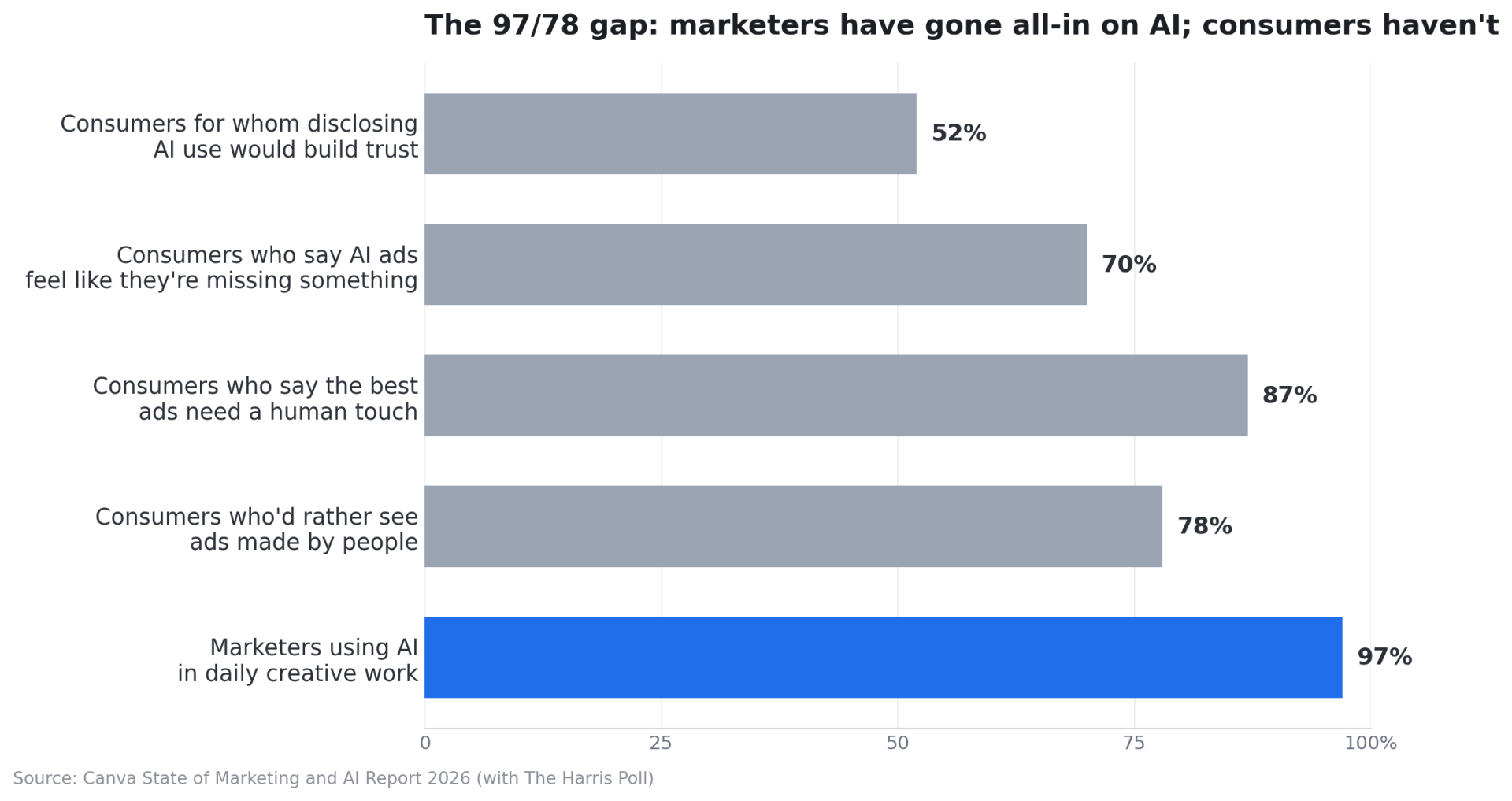
Most of us can feel it now — that small flicker of suspicion when an ad or an email lands just a bit too smooth, a bit too generic, like nobody really sat down to write it. Canva has just put numbers to the feeling. In its State of Marketing and AI Report, published in May, 97% of marketing leaders say they use AI in their daily creative work, while 78% of consumers say they'd rather see advertising made by people — even when AI could do it better, not just cheaper or faster. They still don't want it.
The easy thing to do with a gap that wide is explain it away. Maybe the machines aren't quite good enough yet, and the numbers will close as the output improves. Maybe customers are just being sentimental, the way people grumbled about self-checkouts before they started using them, and they'll come round. I don't buy either.
What unsettles people is something simpler and harder to fix: the sense that nobody on the other end actually cared — that the thing in front of them rolled off a line rather than came out of a head. The technology is rarely the real problem; the missing human almost always is.
That distinction matters, because it points at a completely different response. If the problem were the technology, the sensible thing would be to wait for it to improve. If the problem is the disappearance of visible human judgement, waiting makes it worse. The answer isn't to use less AI — that ship has sailed for 97% of the market. It's to make sure your fingerprints are still on the work.
The gap isn't about quality
Look closer at what those consumers actually said — Canva ran the survey with The Harris Poll, polling more than 3,500 of them — and the picture sharpens. Eighty-seven per cent believe the best advertising still requires a human touch. Seven in ten say AI-made ads feel like they're "missing something". And yet 68% don't mind AI in the mix at all, as long as the result is genuinely helpful or relevant to them.
What they're responding to is judgement. Work that had a person's discernment in it reads differently from work that didn't, and people feel that difference long before they can name it.
This is the same instinct I wrote about a few weeks ago, when I argued that typos are becoming a trust signal — that in a world where anyone can generate flawless copy in seconds, the visible evidence of a real human becomes the scarce, valuable thing. The trust gap is that idea at scale. Polish used to signal effort. Now polish is free, and effort has to show up somewhere else.
Why hiding the machine backfires
What owners reach for constantly is to use AI everywhere and simply say nothing, letting the customer assume a person made it. The trouble is that customers have stopped assuming. Canva found mentions of "AI slop" have risen ninefold, which tells you people are now actively scanning for the seams. And when more than half of them (52%) say that openly disclosing AI use is one of the things that would build their trust, staying silent about it amounts to a bet against your own audience's intelligence.
Disclosure is the part owners agonise over, and I don't think there's one right answer — but here's the rule I'd use. Be upfront where trust is part of what you're selling: professional advice, anything to do with health or money, anything where the customer is taking you at your word. A generated holiday-sale banner needs no note attached. A generated reassurance to a worried client does. Owners who get that call right find that owning up to the AI builds trust instead of denting it.
Get caught passing off generated work as hand-made and you don't just lose that one piece of credibility. You teach the customer to discount everything else you've told them. That's an expensive lesson to hand someone for the sake of a slightly slicker campaign.
Where the human has to be visible
So the practical question for an owner has moved past whether to use AI, and on to where the human judgement needs to be obvious. Three places earn the effort.
The first is the promise rather than the production. Nobody needs a human to have set the kerning on your email or resized the images, but they do need to believe a person stands behind the claim it makes. So put a name and a face at the point of accountability — the founder's signature on the sales email, a reply address that reaches an actual human, a real opinion in the newsletter — and let AI handle the production behind it.
Then there's the judgement itself. Deciding what to say, who to say it to, and what to leave out is the part that rings hollow the moment a model makes the call unsupervised. The AI can hand you a hundred options in a heartbeat, but choosing the right one for this particular customer is exactly the work AI doesn't replace. It's the bit you're actually paid for.
Last comes the response, not just the broadcast. A generated newsletter is forgivable in a way that a generated reply to a real complaint never will be. The closer the contact gets to a specific person with a specific problem, the more unmistakably a human needs to be in the room.
Making the hand obvious
None of this requires a manifesto about your "human-first values" — customers can smell that coming a mile off. It's quieter than that. It's the founder recording a thirty-second video instead of commissioning a glossy explainer. It's the line in the footer that says, plainly, where you use AI and where you don't. It's leaving the small human texture in: the aside, the off-script opinion a model would have sanded smooth, because that texture is now the proof that someone was here.
The owners who win here are the ones who are clear about what the machine made and intentional about what stays human. When 97% of your competitors are automating the same surfaces, the visible human stops being a nostalgic indulgence and becomes the one thing that's genuinely hard to copy.
Your customers aren't asking you to put the machines down. They're asking to know there's still someone there when they reach out — and that, not the AI, is what your marketing has to prove now.