GitLab is paying $35 million to become a small business
GitLab's restructuring spends $35m turning a 2,500-person business into 60 small teams. Small firms already have that shape. Here's how to keep yours.
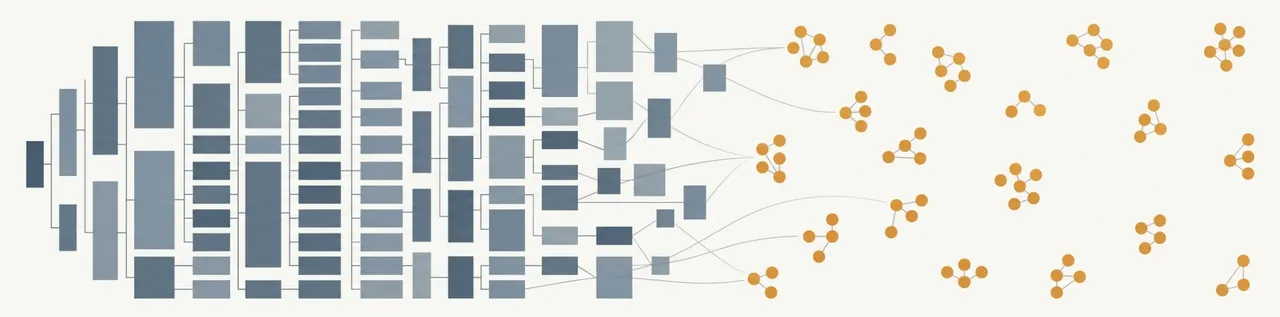
GitLab is a 2,500-person software company with a billion dollars in annual recurring revenue. In May it told staff it would flatten its management structure, removing up to three layers in some functions, and reorganise R&D into roughly 60 small autonomous teams with end-to-end ownership. The bill arrived at June's earnings call: $30–35 million in restructuring charges, around 14% of the workforce affected, and an exit from 22 countries. That's a lot of money to spend on ending up organised the way a twelve-person firm starts out.
What GitLab announced
The memo is worth reading because it's the most concrete public statement yet of what an "agentic era" company is supposed to look like. CEO Bill Staples wants leaders "closer to the work". The 60 teams get end-to-end ownership of what they build, nearly double the number of independent teams GitLab runs today. And the internal reviews and approvals that those management layers used to shepherd will increasingly be done by AI agents. GitLab intends to run on the same agents it sells.
Underneath the AI vocabulary sits a much older piece of logic. Think about what management layers actually do all day: chase updates, collect status, package decisions for the level above. Somebody had to do that full-time, because human coordination is slow and expensive, and that's mainly why org charts grew tall in the first place. Agents collapse the cost of a lot of that work. I'm not sure they can do the judgement half of the job (somebody still has to decide what matters), but the chasing and collating is exactly what they're good at. And once coordination is cheap, the structure that makes sense is a small team that owns an outcome from end to end. Middle management is already being redesigned around orchestration; GitLab's memo takes the same idea and makes it the whole org chart.
Nor is GitLab improvising alone. Coinbase capped its structure at five layers and told staff that every leader must also be an active individual contributor — managers as player-coaches. Cloudflare cut 1,100 jobs under an "AI-native operating model" banner, and earlier this year Block cut more than 4,000 people while posting record profit. The same vocabulary turns up in every one of these announcements, and it has started doing a second job: signalling to recruits, investors and enterprise buyers that a company is built the modern way. The useful reading for the rest of us sits underneath the signalling — big companies are trying to buy back the agility a small firm starts with.
A health warning
Before anyone treats the memo as a model, a few caveats. GitLab's share price has halved in a year and its growth has slowed from 26% to around 16%, so this is a company under pressure announcing the destination before the evidence is in. Simon Willison made the sharper point: a business whose future depends on software demand exploding has every incentive to believe the agentic gospel it's preaching. Sam Altman reckons fewer than 1% of 2025's job losses were actually attributable to AI — he calls the pattern "AI washing". Whether GitLab's bet pays off, I can't tell you; nobody can until the new structure has survived a couple of bad quarters. Even so, the direction looks right to me: coordination is getting cheaper, and org charts will keep flattening because of it.
What this means for a small business
For those of us running businesses of five to fifty people, the direction of travel matters more than the layoff count: the giants are spending tens of millions to end up shaped like us. A twelve-person business is already a small autonomous team that owns its outcomes, the thing GitLab is paying all that money to get back to. We get the shape for nothing; the harder part is keeping it as we grow.
Most small businesses drift the other way, into being miniature corporations. We hire one marketing person and call it the marketing department, we add an approval step because that's what proper companies do, we put in a weekly meeting to keep across it all, etc. Above all, we route every decision through the owner. For years every quote that left my business waited for me to read it first; most of the time I changed nothing, and the waiting was the only thing I added. When I eventually stopped, a couple of quotes did go out with errors I'd have caught — we fixed them and carried on. I'd been a management layer of one without ever appearing on the chart.
Michael Gerber told founders to draw the organisation chart of the company they were going to become and grow into it. Good advice, except the company we were all going to become was a corporation, so we drew little corporations.
What would your 60 small teams look like?
For a small business the number is probably closer to three than 60, but the exercise is still worth an hour of your week. Whatever you redraw, the parts that survive are the ones that need judgement and a name attached; the coordination in between is what's up for renegotiation.
- Draw your business as outcomes rather than functions. Sales, operations and admin are functions; "win the client", "deliver the work" and "get paid" are outcomes. Ask who owns each one end to end. The three-way split won't map cleanly onto every business — it doesn't map perfectly onto mine — but if the answer to all of them is "me", that's the finding.
- List your handoffs. Every status meeting and "where did we get to with this?" email is coordination work — the exact category of work agents are absorbing first. Some handoffs protect quality. Most exist because, at some point, someone made a mistake and a process grew over the scar.
- Count the layers you've built out of habit. A layer here means any pause where work waits for permission, with or without a manager attached. Small businesses rarely have too many managers, but they're rife with moments where the work stops until the owner looks at it.
You don't need to wait for the evidence before running the exercise, though it will be worth following. GitLab's next few earnings calls will start to tell us whether the bet pays — I'll be watching whether the 60 small teams survive their first bad quarter.