Imperfectly human: typos as the new trust signal
As AI commoditises polish, the new premium trust signal in B2B writing is visible evidence of a real human author. Here is why typos now signal trust.
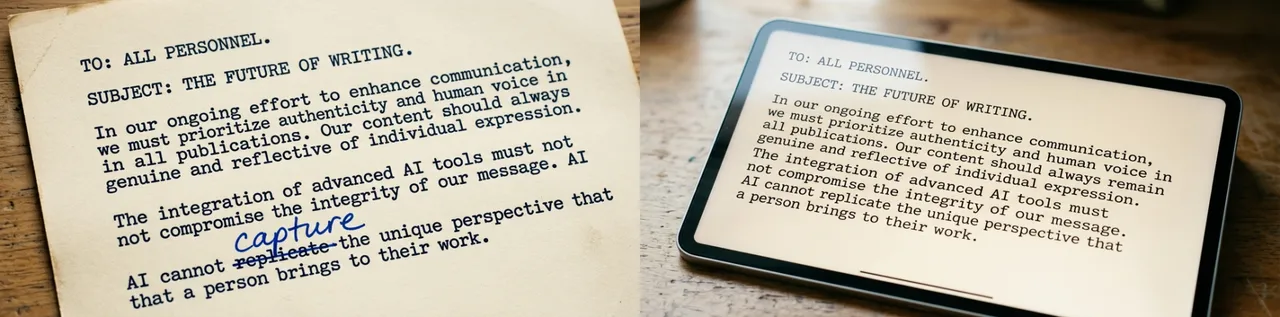
For the last decade, the goal of business communication has been polish. Spell-check, Grammarly, brand guidelines, tone-of-voice documents — all of them pointed in roughly the same direction, which was to tighten the prose and smooth the edges until the writing read as professional rather than as the work of any particular person. A Harvard student has just built the opposite. Sinceerly is a Chrome extension that takes a polished email and roughs it back up: it reads what you've written, removes the AI sheen, drops in a believable typo, shortens a sentence here and there. You can dial it from "subtle" through "human" to "CEO."
As a product, Sinceerly might be a stunt. As a leading indicator, it's worth taking seriously. We're now in a world where polished writing has gone from being relatively expensive to produce to being the default output of any AI tool with a free tier. That shift changes what polish actually signals. Increasingly, the writing we trust is the writing that looks like a real person sat down and typed it.
Why polish stopped working
Polish used to do something useful. A clean email said you cared enough to proofread it. A well-formatted proposal said the firm had its act together. A tight LinkedIn post said the writer had thought about what they wanted to say. The signal worked because polish was costly: it took time, attention, and a person paying attention.
That signal has now collapsed. Anyone with a free ChatGPT account can produce polished prose at scale. Grammarly is built into half the world's email clients. The cost of looking polished has gone to roughly zero, which means polish no longer signals anything about the sender. We've all noticed it. The perfectly-structured cold email with the three-bullet-point value proposition and the call-to-action at the end is now the least trusted shape an email can take, because it's exactly the shape an AI produces by default.
Once a signal is free, it stops doing any signalling work. Marketing has been here before. Think of the brief moment when "as featured in Forbes" meant something, before everyone realised they could pay a contributor for placement. The cost evaporated, the trust went with it. Polish has now crossed that same threshold.
The barbell shows up everywhere
Gary Vaynerchuk has been warning audiences that 100 billion charismatic AI personas are about to join social media — unlike us, they're not real, but they'll seem real. His timeline is roughly three years before we can't tell the difference visually. That arms race is already underway in millions of generated profiles, voices, and videos. That's the bear end of the barbell.
Look at the bull end and you see the same shape from the other side. US vinyl sales topped $1 billion in 2025, the first time since 1983 according to the RIAA. Independent bookshops are growing again. Handwritten thank-you notes still get framed by recipients. Live music has never sold more tickets. The premium isn't on better digital — it's on visible analog, on evidence of a human being on the other side of the thing you're consuming.
The barbell pattern is the same in our communications. The middle — the bland, polished, generic, AI-shaped middle that most of us spend most of our day producing and reading — is where trust is collapsing fastest. The two ends are gaining: extremely high-craft work that's clearly the product of expert human attention, and extremely human work that's clearly the product of some human's attention, typos and all. If you're sitting somewhere in the middle, that's the thing to notice. The AI default is exactly the place trust is leaking out.
What "imperfectly human" actually signals
The reason a typo or a casual phrasing reads as trustworthy isn't that errors are charming. It's that errors are expensive to fake, in a particular way. A polished email is what an AI produces with no extra prompting. A genuinely casual, slightly imperfect email — one that uses the writer's own contractions, leaves a sentence half-finished because the writer changed their mind, drops a typo in a place where the autocorrect would have saved them — takes work to produce or comes naturally from a human who actually wrote it. Either way, it carries information that polish doesn't.
This is exactly the dynamic Sinceerly is exploiting, even if it's doing so cynically. A user runs their AI-generated email through Sinceerly and receives back a roughed-up version that looks like it was tapped out on a phone. The receiver reads it and registers "this came from a person." The signal lands. Whether the sender deserves the credit is a separate question, and one the next generation of trust signals will have to figure out.
I'm not sure how durable Sinceerly's particular trick will be. Once enough recipients know that polished AI emails get reverse-engineered into faux-casual ones, the casual register starts pattern-matching as AI too, and we move on to whatever the next signal is. The deeper shift, though — that human authorship is now the thing being valued — looks structural rather than faddy.
For brands and individuals who actually do write their own communications, the lesson is simpler. Stop scrubbing the human-ness out. The audit-trail of an actual person — the clipped sentence, the slightly off-brand phrase, the paragraph that breaks the rules of the style guide — is what your audience is increasingly looking for.
Practical strategies for B2B communications
For business leaders thinking about what this means for their brand and their team's writing, here are four practical moves:
- Stop polishing for the sake of polish. Have your team review what they're sending and ask whether the smoothing they're doing is adding clarity or just adding AI-shaped texture. If a paragraph reads like every other corporate paragraph, it's working against you.
- Let voice idiosyncrasies through. Every senior person in your business has speech patterns, opinions, and a way of phrasing things. Style guides have spent fifteen years sanding those off. The next ten years will be about putting them back in. The CEO who writes the way they actually talk will out-trust the CEO whose LinkedIn reads like it was generated by their agency.
- Reserve high-craft for the moments it matters. When you're writing a strategic essay, a major announcement, or a piece of thought leadership that has to land, polish is still load-bearing. The barbell logic only works if the high-craft end is genuinely high-craft. Don't read this as licence to ship sloppy work everywhere. Read it as licence to stop polishing the day-to-day and to invest the saved attention in what actually matters.
- Audit your AI-generated outputs for sterility. If your team is using AI for first drafts (as most teams now are), build in a step where the human owner adds back the texture: the half-finished thought, the unexpected verb choice, the bit of personality. A practical way to do this on, say, a sales outreach sequence: take the AI-drafted email, read it aloud, and stop at the first sentence that doesn't sound like the way the named sender actually talks. Replace it with one that does. Repeat. Tools like Sinceerly do something similar mechanically; a human owner of the message will usually do it better.
What this means for the next phase of marketing
We've spent the last few years watching AI eat the polishing layer of marketing. Copy editing, formatting, basic content production: these are all becoming free goods. That's prompted plenty of hand-wringing about the future of the marketing function. The more useful framing is that the value has migrated. As I argued in AI didn't break marketing — it exposed what wasn't working, the exposing has been useful. What's left is the work AI can't do for free: judgement, taste, point of view, evidence of a real person paying attention. The hard numbers caught up with this soon after: Canva found a 97/78 trust gap between the marketers who've adopted AI and the customers who'd still rather see work made by people.
The trust signal is following the value. As polish becomes commodity, the next premium signal is the one Sinceerly is faking: visible evidence that a person was here. The businesses that win the next round of attention won't be those with the cleanest copy. They'll be those whose writing sounds like it came from someone who actually has something to say, and who couldn't quite be bothered to sand off the bits that proved it.
Quick answers
Are typos really a trust signal now?
Not on their own. A typo in a contract is still a problem, and you wouldn't want one in a public-facing landing page. But in informal communications — emails, DMs, social posts — visible evidence of a human author has started doing real signalling work. The polished alternative now pattern-matches as AI by default, which is the shift this article is about.
What is Sinceerly?
It's a Chrome extension launched in April 2026 by Ben Horwitz, a Harvard Business School student. You paste in an AI-generated email and it gives you back a roughed-up version with believable typos and dropped formality. Its existence is more interesting than its features — it's a marker for the moment when the polish layer of AI-generated writing started to read as a problem rather than a quality bar.
Should we stop using Grammarly, and is this just an anti-AI trend?
No to both. Polish tools are still useful for things that need to be precise — contracts, proposals, public-facing pages, anything legally sensitive. And most of the people writing about authenticity still use AI heavily; what's changed is the specific work AI now does for free. Polish has been removed from the list of things that signal effort. Visible humanness is filling the gap. That's a response to AI, not a rejection of it.