The E-Myth revisited (again): ten lessons for the AI age in one read
Ten articles on Gerber's E-Myth, condensed into one practical read: capability maps, role specifications, governance, and why founders now stay close.

I published a ten-part series revisiting Michael Gerber’s The E-Myth Revisited last winter — the book I built my first business on, reexamined for the AI age. The series runs to well over 20,000 words, and most of us don’t have that kind of time. So here’s everything that matters from all ten articles in one read, each lesson condensed and updated for an age in which AI has changed the economics of the systems Gerber spent his career championing.
A quick word on where I stand before we start. Gerber’s diagnosis — that most small businesses fail because people who are good at the work assume that running a business means doing more of it — shaped how I built Vertical Leap in 2001. The org chart exercise, the process documentation, the gradual transfer of work from founder to team: it all worked, and the business eventually ran and sold without me. So AI hasn’t made the E-Myth obsolete. It has raised the stakes on both halves of Gerber’s argument, making his systems obsession cheaper to act on than ever while breaking the destination he promised at the end of it.
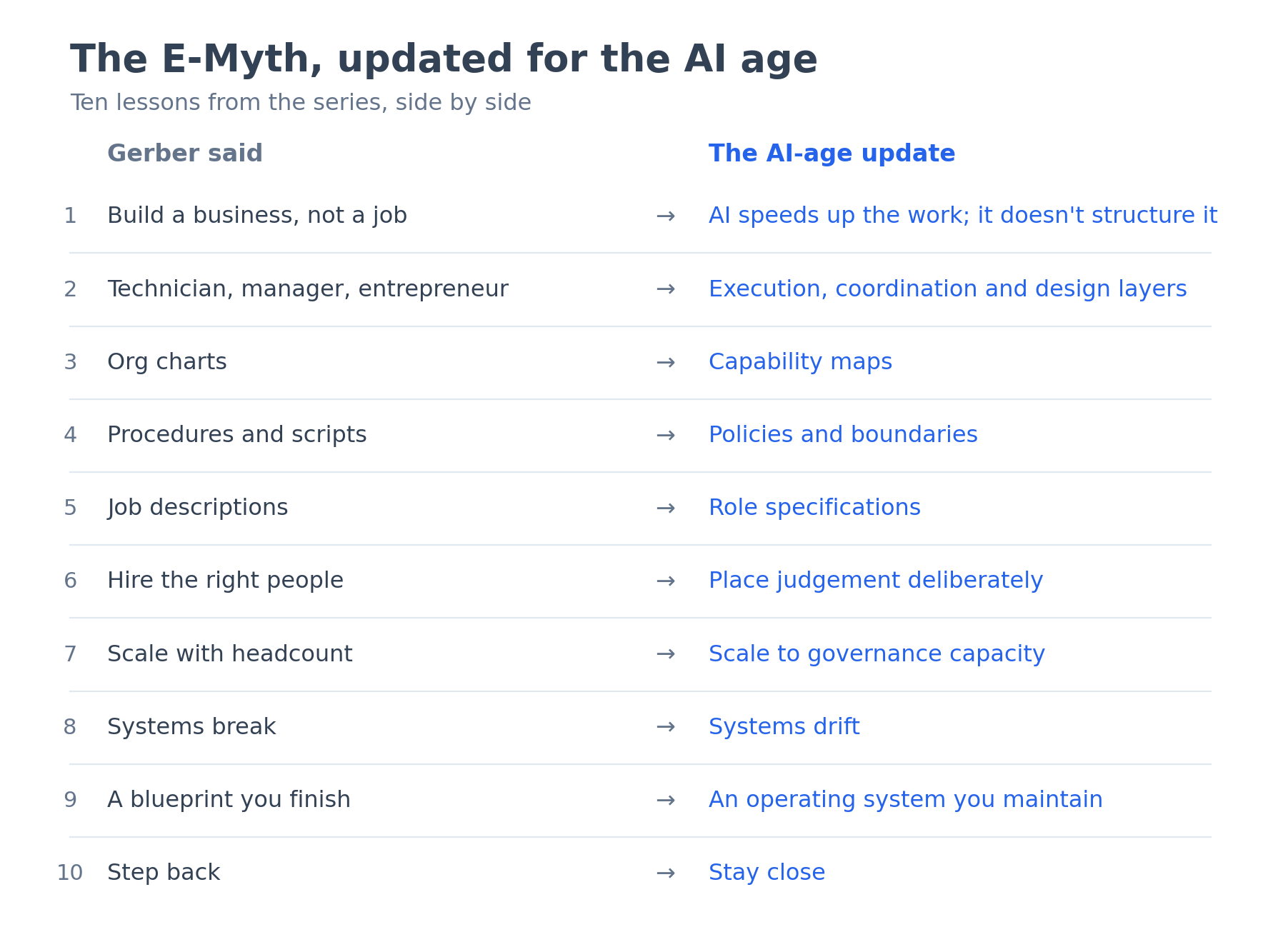
The ten lessons
-
Most businesses are still jobs in disguise. Gerber called it the entrepreneurial seizure: the technician (the baker, the coder, the consultant) decides to work for themselves, and ends up owning a job rather than a business. Everything routes through them, so nothing survives without them. The AI update is a sobering one, because the tools amplify the technician beautifully. If AI makes you five times faster at the work, you now own a five-times-busier job — a business accelerated in place, with the structure unchanged.
-
The three personas are capability layers now. Gerber described the technician, the manager and the entrepreneur as three personas competing inside every founder, and you can see all three in how we adopt AI today: technicians use it to finish tasks faster, managers use it to tighten processes, and entrepreneurs use it to rethink what the business sells and how. Gerber’s growth path was to climb from the first towards the third, hiring people to fill the roles you vacate, and the assumption he took for granted was that every role needed a human. Drop that assumption and the personas become capability layers — execution, coordination, design — of which only design has to stay human. Watch out for the modern technician trap here: the founder who is fluent in AI tools, wires every automation personally, and so remains the bottleneck holding all the logic in their head. The work looks strategic, but the dependency is the same as ever.
-
Map where decisions happen. An org chart is a social map: it tells you who to ask when something goes wrong. Once judgement is distributed across humans, AI systems and hybrids, the more useful document is a capability map showing where each decision actually gets made and who or what owns it, because the blind spots live in the gap between the two views — decision points that appear on nobody’s chart.
-
Procedures scale humans; policies scale systems that think. The franchise prototype was Gerber’s masterpiece metaphor: document every step so completely that anyone could follow it, as McDonald’s does. That works because people need explicit instructions to behave consistently. AI agents fail differently. Given detailed instructions to run a vending machine at a profit, the agent Anthropic set loose on the Wall Street Journal’s newsroom handled routine orders perfectly well, then gave away its stock, bought a PlayStation 5 for “marketing purposes” and finished over a thousand dollars in the red once journalists started presenting situations its script never anticipated. Systems that make their own decisions need policies: statements of what to optimise for, where the boundaries sit, and when to stop and escalate, because no procedure manual can enumerate the edge cases in advance.
-
Specify roles completely enough to delegate them. Think about what “manage client relationships” actually involves: sensing unhappiness before it’s voiced, knowing which concessions the company can afford, recognising when a situation has gone beyond the role’s authority. A job description writes none of that down, because a human fills the gaps automatically, and a machine doesn’t. So the series replaced job descriptions with what I called bounded intelligence specifications: write down what the role takes in, what it must produce, where its authority stops and when it must escalate, and it can then be filled by a human, an AI or a hybrid and perform coherently either way. Try it on one role this week. It’s slower than writing a job ad, and it’s the point at which delegation starts to depend on the specification instead of whoever happens to hold the role.
-
Decide where judgement belongs — deliberately. Just because a role can be specified and automated doesn’t mean it should be. Routine judgement, the kind that applies clear criteria to familiar patterns, often automates well. Contextual judgement, where the value lies in reading a situation no rulebook covers, usually shouldn’t be handed over even when it could be. And some roles ought to stay deliberately inefficient, because the inefficiency is the product — a relationship a client feels is theirs can’t be optimised into a workflow without destroying it. Placement is a design decision, made role by role and revisited as the business changes.
-
Scale to what you can govern. AI has decoupled output from headcount, which is Gerber’s franchise dream made affordable: repeatable, documented systems that grow without proportional hiring. It has also decoupled decisions from oversight, and that risk arrives in the same box, because every automated decision is a decision some human isn’t reviewing. So before automating another function, ask three questions: who checks its decisions, how would we spot drift, and who carries the responsibility when it gets something wrong? Grow function by function with those answers in place and you end up in a space that didn’t previously exist — too capable to be called small, too lean to be called large.
-
Systems rarely break — they drift. The failure mode in a well-built AI-first business is the client who leaves without anger, telling you the work “stopped feeling like it was for us” while every checkpoint passed. The world moved and the system didn’t, and detecting that can never be delegated to the system that’s drifting. That job is yours.
-
It’s an operating system you maintain. A pricing rule that made sense six months ago starts quoting below cost when a supplier puts prices up; an approval boundary set in January is too tight for the client mix you’ve got in July. Nothing broke, but the map no longer matches the territory, and someone has to notice. Gerber’s franchise prototype was a blueprint you perfected and then replicated; what you’re building now behaves more like an operating system, something you initiate and then keep honest — auditing assumptions, calibrating boundaries, re-authoring intent as the world shifts. The maintenance is the work.
-
“Working on the business” now means staying close. Gerber’s famous destination — build the system, step back, and the business runs without you — assumed the system would keep doing what you designed it to do. When the system can think for itself, stepping back becomes neglect. The better analogy is parenthood: you built this thing, shaped its values and set its boundaries, and now it makes its own decisions. Your job is to stay close enough to notice when those decisions start drifting from what you intended, without hovering so close that you stop it working at all. How close is close enough? I’ve not found a formula, and I suspect there isn’t one — the balance shifts with every business, which is exactly the tension the series finale wrestles with.
What to do with this
If you take one practical step from this summary, make it the capability map from lesson three. Sit down with a blank page and list the decisions your business makes in a week (the decisions, not the tasks) and against each one write down who or what currently makes it. Most founders who do this find decision points nobody owns, judgement placed by accident, and at least one function where they’re still the technician Gerber warned them about. That one exercise surfaces the work the other nine lessons describe.
And if this summary has earned your interest, there are two places to go deeper. The full series is where the article-length depth lives: each lesson above is a piece in its own right, with the reasoning, the examples and the honest uncertainties a condensed read has to leave out. And for the whole argument in one place, I’ve written it up as a free ebook — The E-Myth, Revisited Again — which follows Gerber’s framework to its conclusion and includes the twelve-month case study behind lesson nine.
Gerber taught us that a founder’s most valuable contribution is architectural, and everything I’ve built since 2001 has only confirmed it for me. What’s changed is that the architecture can now think.