The AI doom cycle: why your team is stuck at stage 3
A team going quiet on AI isn't proof the tools failed. It's stage three of the doom cycle: a predictable adoption valley, and a management job to fix.

Six months ago your team couldn't stop talking about AI. Someone had got Claude to draft a proposal in the time it takes to make a coffee. Someone else had handed over the weekly report and watched a morning's work shrink to ten minutes. The channel was busy. There was a sense, briefly, that the way you all worked was about to change.
Now it's gone quiet.
Nobody decided to stop. There was no meeting, no memo, no verdict handed down. The tools are still paid for and still open in a tab somewhere. But the energy has drained out of the room, and if you ask around you'll get a shrug and some version of the same answer — it was good for a bit, then it got something badly wrong, then it started to feel like more effort than it was worth. Everyone just slid back to how they worked before.
I've seen this happen enough times now to think it deserves a name. Call it the doom cycle. It runs in five stages, and the trouble is that most teams get stuck at the third — and then mistake being stuck for having reached the end.
What the doom cycle looks like
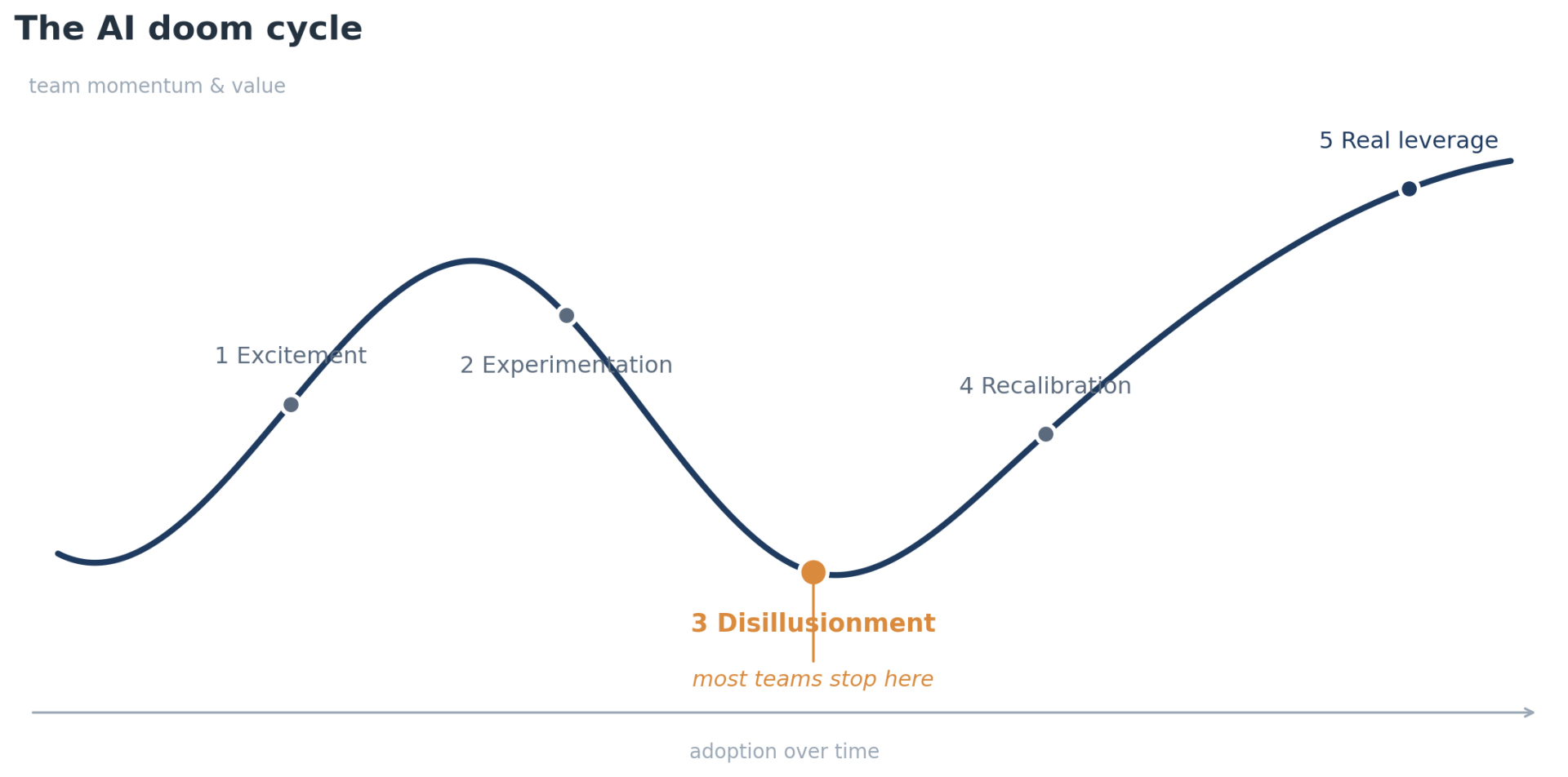
The cycle goes like this. Excitement comes first: everyone tries it, the early wins feel like magic, and for a fortnight the future looks obvious. Then experimentation, which sounds healthy but rarely is — it's scattered and individual, everyone poking at their own corner with nobody comparing notes. Then disillusionment, stage three, when the gap between the demo and the actual job becomes impossible to ignore. Someone gets burned by a confident, fluent, completely wrong answer. The tool turns out to be slower than the spreadsheet for the thing they do all day. Trust collapses faster than it built, and usage falls away.
Most teams stop here, reading the slump as a result rather than a stage — the hype was overblown, they conclude, the emperor has no clothes, we gave it a fair go and it didn't deliver. Which is about the most expensive misreading in business right now.
Because there are two more stages, and they're where all the value lives. Stage four is recalibration — the survivors stop asking AI to be everything and work out the handful of things it's genuinely brilliant at. Stage five is real leverage, when those few things are wired into how the team works, every day, by default. The teams that reach stage five run the very same tools as the teams stuck at stage three. What carries them across the valley is a process — a deliberate, slightly boring process that somebody owns.
Why stage three traps teams
Stage three is where adoption either gets a process or dies. Read the slump as a signal to stop and you've made that call on everyone's behalf. The disillusionment is real — the team isn't imagining the bad answers or the wasted afternoons. But it's a stage, not a destination, and treating it as a destination is a management failure wearing the costume of a sober technology verdict.
Not every retreat is a mistake, mind you. Sometimes the tool genuinely doesn't fit the work, and that's exactly where a sensible team ought to stop. From the outside it's genuinely hard to say which kind of quiet I'm hearing, but the difference usually shows in what the team tried. One that ran three workflows properly for a month and dropped them has learned something real. One that poked at a chatbot for a fortnight and gave up hasn't. Almost everyone sitting in the trough is the second kind: they've decided it doesn't fit without ever having built anything for it to fit into.
Calling it a management problem can sound like blaming the team for not trying hard enough. That's not what I mean. I've argued before that most AI projects fail for reasons that have nothing to do with the model — the technology works fine; it's the execution around it that collapses. The doom cycle is the same truth seen from inside a team rather than from the top of a project plan. Nobody was made responsible for getting the group from “everyone's playing with it” to “this is how we write the monthly report now.” So it never happened. The drift back to the old way wasn't a decision anyone took; it's just what fills the space when no one has been told to fill it with something else.
None of this is peculiar to AI. We've been here before, more than once. Gartner even has a name for the dip — the trough of disillusionment, the part of the curve where early excitement collides with the unglamorous business of making something work. The web had it. Mobile had it. Cloud had it — plenty of serious people wrote it off as a security risk no sensible company would touch, right up until it became the default. Each wave produced its own burst of confident commentary declaring the whole thing oversold, at exactly the moment the disciplined operators were busy building the processes that would make it pay. If anything AI is a bigger shift than those, not a smaller one, which is exactly why waiting for the disappointment to pass is the wrong instinct. The pattern is reliable to the point of being boring. What's never boring is being the business that mistakes the trough for the end and steps off the curve.
How to get through the valley
So what does getting through stage three actually look like? Less than people expect, and more boring than they'd like.
It starts with choosing. Not thirty use cases — three. Pick a small number of real workflows where AI does something you can point at and measure: the first draft of a proposal, the support reply, the meeting notes turned into actions. A team that's spectacular at three things will beat one that's mediocre at thirty.
Then measure them honestly. Honestly is the load-bearing word. Not “does this feel futuristic” but “did it save Priya twenty minutes a day, and is the output good enough that nobody has to quietly redo it afterwards?” If the answer's no, drop that use case without ceremony and keep the ones that earn their place.
Then make it shared. The reason stage two wastes so much is that everyone learns the same lessons separately and none of it compounds. Build a shared library of prompts that work. Agree the review step — what a human checks before an AI draft goes out, every time. Turn one person's clever discovery into the team's default way of doing the thing. None of this is glamorous, and people will drag their feet over it; a shared review step feels like bureaucracy right up to the day it catches something embarrassing before a client does.
And finally, the part nobody wants to own: put someone in charge. Not “the team.” A person, with their name against it, whose job is to drag these few workflows from novelty to habit. The teams that reach stage five almost always have one. The teams stuck at stage three almost never do.
If your team has gone quiet on AI, be honest about what the silence is actually telling you. It's tempting to file it as a verdict — we tried it, it wasn't all it was cracked up to be. But the tools didn't go quiet on their own. Somebody has to carry a new way of working across the valley, and on most teams that silence is simply the sound of a job nobody was ever given.