I rewrote the E-Myth for the age of AI agents
Gerber taught founders to build a business that runs without them. My new free book is about building one that can think for itself — and stays yours.
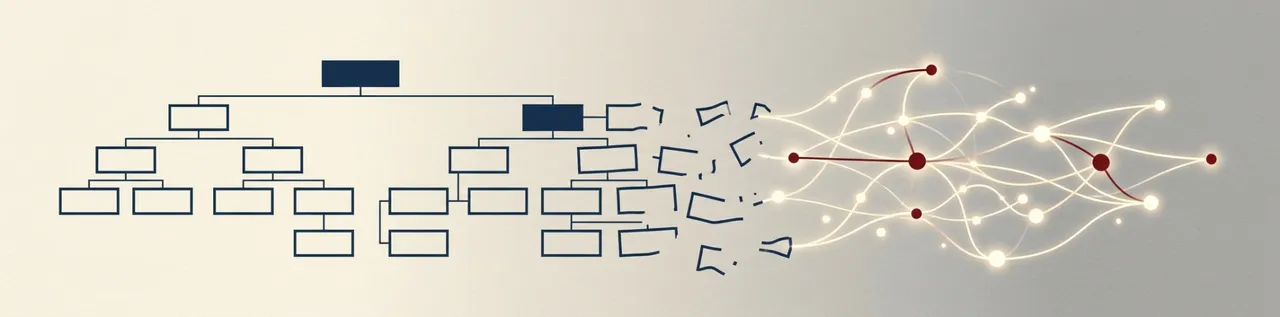
I built my first business with The E-Myth Revisited open on the desk. Not loosely — literally. When I started Vertical Leap I drew the org chart with my name in every box, documented every process until someone else could run it, and separated the technician work from the manager work from the entrepreneur work, exactly as Gerber prescribed. It worked. The business grew, ran without me, and eventually sold — the endgame John Warrillow maps step by step, and the subject of my review of Built to Sell.
So I say this with real respect: the E-Myth, as originally conceived, is no longer enough.
Not because Gerber was wrong. The core insight — that your most valuable contribution as a founder is architectural, not operational — is as true today as it was in 1995. What's changed is the assumption underneath it. Gerber assumed every role needed a human. Remove that assumption and the framework doesn't collapse. It transforms.
Most people still meet AI as an assistant: you give it an instruction, it produces an output, you check the result. Useful — but you're still the one doing the deciding, and you remain the loop. The shift that actually matters is the agent: you give it a goal and it plans, acts, and keeps going across many steps, often without you watching each one. The moment AI stops producing drafts and starts taking actions, "delegation" means something it never meant before.
That's where the old failure mode comes back, wearing a strategic hat. Gerber's technician was the founder who couldn't stop doing the work. The modern version is the founder who's fluent in AI — knows how to prompt, wire automations, get results — and therefore stays central to everything. The work looks strategic. The dependency is identical. The old trap was "I must do everything myself." The new one is "the system is doing everything, but I no longer know why." That's not the smaller risk. It's the larger one. It is also why the real barrier to handing work over to AI is rarely the tooling; as I argued when Claude for Small Business removed every barrier but the one that matters, the thing that stops most owners delegating is that they have never defined the work clearly enough to hand it to anyone.
So I wrote a book about it: The E-Myth, Revisited Again. It follows Gerber's framework to its conclusion in an AI-first world — capability maps instead of org charts, roles defined as bounded intelligence, deciding where human judgement actually belongs, and which limits you build into the tools rather than trusting to a prompt. There's a twelve-month case study of one founder, Sarah, building the whole operating system from scratch: the specifications that were forty per cent right on the first draft, the governance that felt like overhead until the day it saved a client relationship, the moment a system quietly started drifting from what she'd intended.
It isn't a tools book. It won't tell you which app to buy. It's about how to design a business when the work can think for itself — and how to keep what makes it yours rather than handing it, piece by piece, to whichever model you happen to be renting.
I'm giving it away. You can download it free here: The E-Myth, Revisited Again. Read it, and if you want to take the ideas further, that's what AI: Beyond the Prompt is for.
If you built your business on Gerber, think of this as the next chapter. If you never read him, it stands on its own — though I'd still put the original on your shelf. He earned his place there.