Intelligence has always been a commodity
AI models are commoditising and human intelligence always was. Being smart was never scarce — the container you build around it is what creates value.

Think of the smartest person you know — smartest, not most successful. The one who picked things up faster than everybody else at school, who can hold a whole argument together in their head while you're still looking for a pen. Now ask yourself what they've built.
For a lot of us the answer is slightly awkward. Some of the sharpest people I've worked with over the past thirty years have never built much of anything. They're marvellous company, they're right more often than they're wrong, and they've been about to do something remarkable for two decades. The people who did build things — the ones with staff and customers and a business that keeps running while they're on holiday — are frequently the second or third smartest person in any room they walk into.
That gap is what this article is about, because raw intelligence was never the scarce ingredient in building anything. What's scarce is the container you put it in: the habits, the systems, the taste, the willingness to finish. And it's worth saying out loud now because the AI industry has spent this year discovering the same thing about itself and reporting it as news.
The models are converging
For three years the working assumption was that whoever held the best model would win, and that assumption is coming apart. Moonshot AI released Kimi K3 this month with open weights at $3 per million input tokens and $15 per million output, against Sol's $5 and $30. Days later Alibaba previewed Qwen3.8 Max — 2.4 trillion parameters, described by Alibaba as second only to Anthropic's Fable 5 — and said it would open the weights too. The frontier has stopped looking like a fortress.
Ben Thompson set out the economics of this on Stratechery, and he draws a distinction worth holding onto: tokens aren't a commodity, because different models burn wildly different numbers of them to reach the same answer, so a cheaper token isn't automatically a cheaper answer. What's interchangeable is the answer itself. “We are rapidly approaching a state,” he writes, “in which intelligence for many economically beneficial tasks is in fact a commodity.”
Where the labs differentiate instead, he argues, is by integrating up into the customer experience — the harness, the product, the thing you actually sit in front of every day. Whichever one you start with is probably the one you'll stay with.
Read that back and you've got the industry version of the observation we opened with: intelligence is cheap and abundant, and the container you put it in is where the money sits.
Where the analogy breaks down
The analogy needs handling honestly, because it doesn't hold perfectly. Human intelligence isn't a commodity in the way oil or copper is. It isn't fungible and it isn't tradeable — it arrives embodied in one particular person with one particular history, and you can't buy a barrel of it.
The tighter claim is that intelligence has always been cheap relative to the things that convert it into value. Think of the two accountants you've used: one of them was probably sharper, and the other was the one who actually filed on time. Being smart is common; follow-through isn't, and neither is the judgement to know which of four good ideas is worth actually pursuing. What AI has done is turn that economics from true into literal: intelligence is now disembodied, rentable by the token, and getting cheaper every quarter. Which removes the last hiding place. When the thinking shows up as a line on a monthly bill, everything you compete on is the part you wrap around it.
What the hiring research says
Good interviewers have been inspecting the container for years without calling it that. A structured interview asks how somebody has handled things: whether they finished, how they decided, what they did when it went wrong. It's a crude look at the container rather than the contents, and the evidence now says it works better than measuring the contents directly.
For most of my career the received wisdom in recruitment was the opposite — that a test of general cognitive ability was the best single predictor of how well somebody would do a job. In 2022 Paul Sackett and colleagues went back through the meta-analytic evidence and found the statistical corrections underpinning that claim had been overstating it for decades. On more conservative maths, general mental ability came out around r = .31 — useful, and no longer top of the list. The structured interview came out strongest, at roughly .42. Plain conscientiousness scored lower, around .20, but it adds predictive power on top of intelligence instead of overlapping with it.
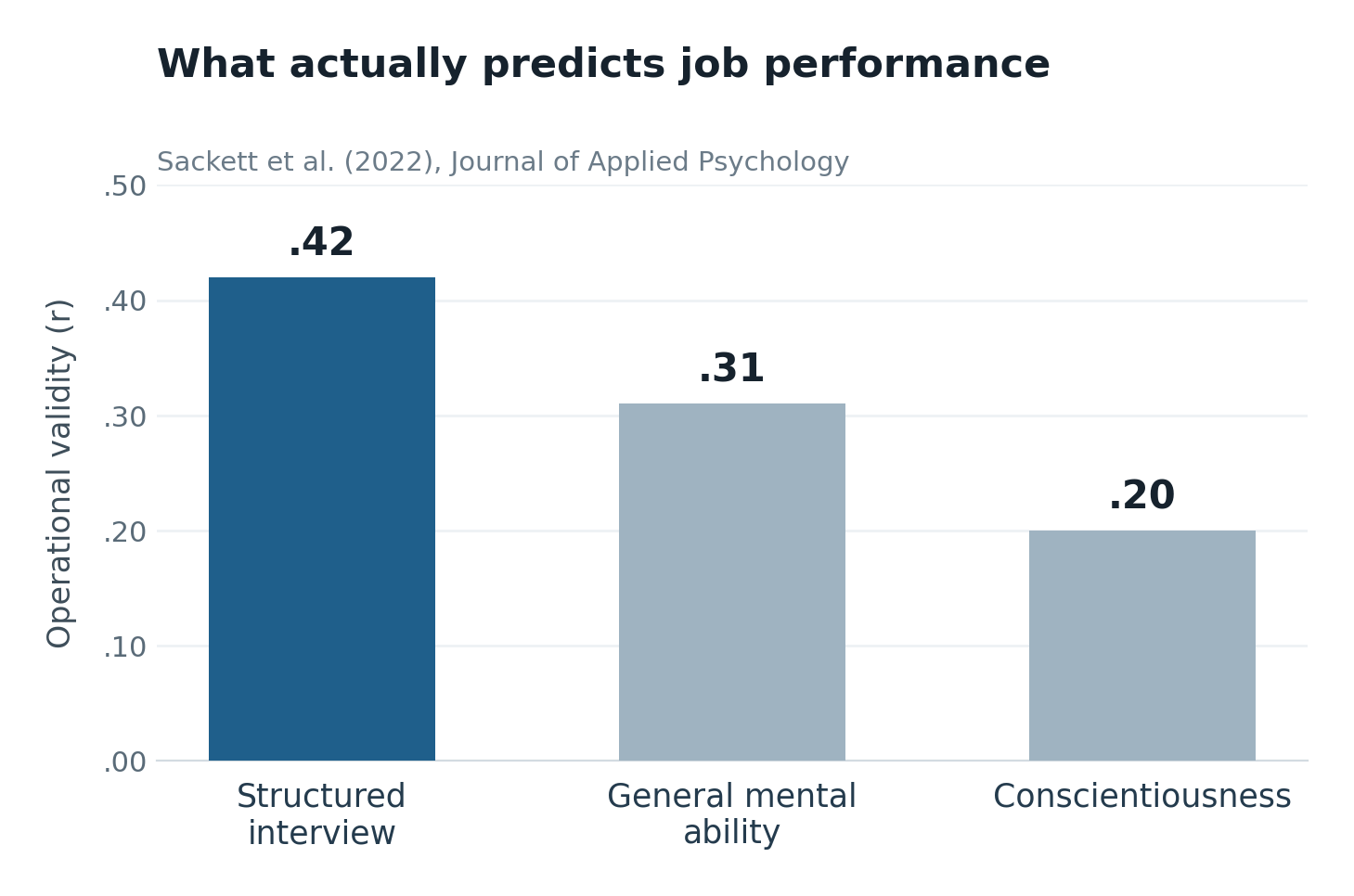
The premium, it turns out, is on evidence of conversion. We all do this instinctively when we hire. We ask for examples, we ring the referee, we want to know whether the last thing they promised actually landed.
The technician and the business
Michael Gerber made this point to small business owners nearly forty years ago and it remains the most useful thing in The E-Myth Revisited. The best baker in town doesn't automatically have a bakery. Skill at the work and a business that reliably delivers the work are two different objects, and the fatal move is assuming the first produces the second. I've written before about what “working on the business” means now, and Gerber's advice has aged well enough that AI has turned it from aspiration into homework.
Something has changed since he wrote it, though. Gerber's technician at least owned a scarce skill. Yours may not be scarce by Christmas. If what you sell is essentially applied intelligence — analysis, copy, design, code, advice — then the smart part is being commoditised underneath you, on somebody else's roadmap, at a price you don't set. The container used to be the thing that scaled your advantage; now it's the whole of it.
Building the container
I've argued the strategy version of this before: when everybody runs their thinking through the same models, their plans start to look the same. The container argument goes wider than strategy documents, though. If intelligence is the cheap input, the work is everything in your business that turns it into output somebody will pay for.
I'm not certain how durable that is. Systems get copied, taste can be imitated, and the models are getting better at both. But the businesses I watch pulling ahead tend to be the ones where somebody has done the unglamorous work of building a container that converts.
Four places to put your effort:
- Write down how you actually work. If a process lives only in your head, it's a bottleneck. It's also the raw material that makes a general-purpose model behave as though it works here, in your business, and nowhere else.
- Get your own data somewhere usable. Your service history, the complaints your customers really make, fifteen years of pattern-spotting nobody has ever written down. The public data is shared with everyone; this isn't.
- Decide what you're for. The model will hand you the sensible answer, and the sensible answer is now available to every competitor for a few dollars a million tokens. That makes it a baseline rather than a plan. What you choose not to do is the interesting part.
- Hire and manage for conversion. Look hard at what people have finished, not how quickly they think. Then be the system that gets what they can do out of the door.
None of this is new advice, which is more or less the point. The smart people we all know who never built anything weren't short of intelligence, and neither now is anybody else. What separates the businesses that get somewhere is the discipline to turn thinking into work that's finished — the one part of this you still can't rent by the token.