When every device can think: the agentic everything future
Smart devices are becoming agentic systems that understand context, take bounded action, and quietly redraw work, authority, governance, and trust.
A smart device used to mean something with Wi-Fi and a half-decent app.
That bar is now absurdly low.
The real shift is not that devices are becoming smarter. It is that they are becoming both intelligent and agentic — and those are not the same thing.
An intelligent device can recognise what is happening around it. An agentic device can do something useful about it.
Most of the current commentary still misses that distinction.
We have spent years building dashboards, notifications, and warning lights. Better mirrors, basically. They can be very good mirrors, but they still leave the human carrying the operational burden. See the alert. Interpret the alert. Decide what to do. Do the admin. Chase the follow-up. Carry the blame.
Agentic systems change the shape of that work.
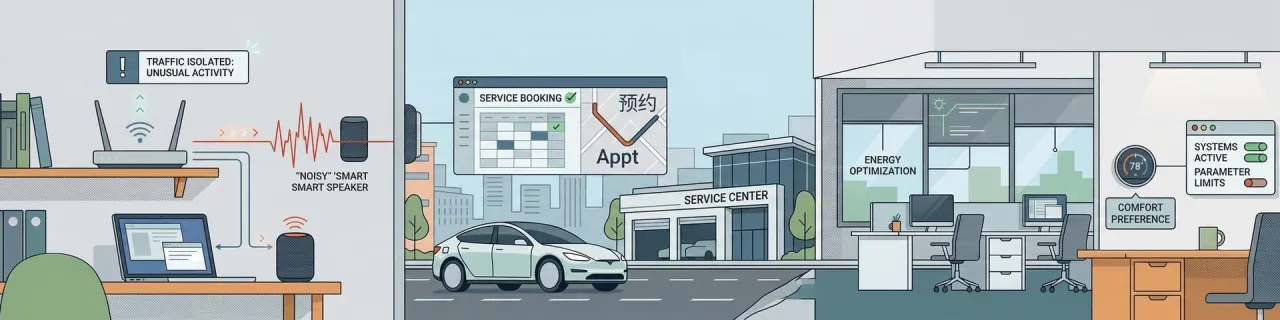
Take a router. The old model tells you there is suspicious traffic on the network. The more intelligent version recognises that one device is behaving abnormally, spots the likely pattern, and can tell you what probably went wrong. The agentic version goes a step further — it isolates the device, logs the event, and tells you what it has done.
Or take a car. The old model gives you a warning light and leaves you to figure out the rest. A more intelligent system can interpret the fault in context and explain what is likely wrong. The agentic version can contact your regular garage, suggest appointment slots, handle the booking, and put the details in your calendar.
That is the threshold: not smarter notifications, but delegated action inside clear boundaries.
Why “smart device” is now too weak a phrase
"Smart" used to be a useful word because it distinguished connected devices from dumb ones.
Now it mostly blurs the thing that matters.
A connected thermostat is not especially interesting. A thermostat that understands occupancy patterns, weather, tariff windows, and the thermal behaviour of the building is more interesting. One that can use that understanding to optimise heating within rules you have already set is something else again.
The same pattern turns up everywhere. Security systems. Vehicles. Warehouses. Fleet platforms. Energy controls. Building management. Ordinary equipment is picking up enough local context to make sense of what it sees — and, increasingly, enough authority to act.
The phrase agentic everything sounds dramatic.
It is also broadly right.
Once intelligence becomes cheap enough to embed almost anywhere, the question stops being "which device is smart?" and becomes "which systems are still passive?"
Bounded intelligence is useful because it is narrow
This is where people often get distracted by the wrong sci-fi.
The devices that matter most will not be little artificial general intelligences sitting in your kitchen trying to become your best mate. They will be narrower than that, more boring than that, and far more useful.
Bounded intelligence means the system understands enough of its immediate environment to interpret what is happening in context. Not everything. Just enough.
A router does not need a worldview. It needs to know what normal traffic looks like on your network, what a compromised device might look like, and what actions sit inside its remit.
A car maintenance system does not need to ponder existence. It needs to connect fault signals, service history, location, calendar availability, driver preferences, and perhaps the garage relationship.
That narrowness is the whole point.
The more tightly the intelligence is tied to real context, the more dependable the resulting action can become.
Agentic behaviour is the real threshold
This is the part that changes workflow design.
A system that only informs still leaves the human as the coordinator of everything that follows. A system that can act within bounds starts to remove low-value coordination work altogether.
Ford's new fleet AI is a decent example of direction here. It is being positioned inside telematics software as a way to analyse manufacturer-grade vehicle data, answer operational questions, surface insights, and draft outputs for fleet managers — but still in a read-only, human-in-the-loop mode. That is not full autonomy, and it does not need to be. It shows the line moving from dashboard to participant.
You can see the same shift from the platform side as well. Nvidia's reported NemoClaw move matters not because it makes devices magical, but because it points to the infrastructure needed for bounded agents to operate across ordinary systems with security, privacy, and orchestration built in.
And then there is the harder edge. Amazon has already won a preliminary injunction blocking Perplexity's agents from shopping on its marketplace. That is a useful reminder that capability is only half the story. Agentic systems do not just need intelligence. They need permission.
Which brings us to the real management problem.
When devices can act, authority becomes a design decision
The hard part is not making systems look clever.
The hard part is deciding what they may do, when they may do it, and how you know when they have crossed a line.
Who is allowed to let the system act? What requires approval? What happens when two agents optimise for different things? Who owns the outcome when the local decision made sense but the overall result was wrong?
This market will not be won by the cleverest model alone.
It will be won by the companies that solve orchestration, permissions, logging, escalation, and trust in ways normal organisations can actually live with.
A dashboard is no longer just a mirror. It becomes a junior operator, which sits very close to the management redesign described in The 50:1 AI org chart. A building system becomes a facilities coordinator. A vehicle platform becomes an operations assistant. A security tool becomes an active gatekeeper.
Useful.
Also slightly dangerous if the lane markings are vague.
What this means for a small business
Most small businesses will not encounter this as a grand product reveal. It will arrive through updates to tools they already use.
The booking system starts triaging enquiries before anyone reads them. The stock platform spots an anomaly and raises a supplier task automatically. The fleet software drafts the customer explanation before the phone rings. The building system adjusts itself around price, occupancy, and policy instead of waiting for somebody to notice a problem.
Bit by bit, the management layer changes.
Some admin disappears. Some coordination work moves sideways. Some human roles become more important because somebody still has to decide the rules, the exception paths, and the kill switch.
For a small team, that is the practical takeaway. Do not ask only whether a system is accurate. Ask what it is allowed to do without you.
Decide the boundaries early. Decide what context it must have before you trust it. Decide who gets the final word when systems disagree.
That is not corporate governance theatre. It is basic management hygiene for the next software era, and it overlaps with the accountability problem in Governance, drift, and responsibility in AI-first firms.
The future will feel ambient, but the consequences are real
A lot of AI commentary still imagines one brilliant assistant sitting in the middle of everything.
I doubt that is where most of the practical value lands.
More likely, intelligence spreads across the edges — dozens of narrower systems, each tied to real context, each able to take bounded action, each a little less passive than the version that came before.
It will feel ambient. Quiet, even.
The consequences are not quiet at all.
When every device can think, even in a limited way, the important question is not whether it understands your world. The important question is whether it has been given permission to change it.
The agentic everything future is not about magical gadgets. It is about ordinary systems becoming active participants in work and daily life.
The winners will be the people and businesses that treat that early as a coordination and authority problem, not a feature upgrade.