AI 2027 one year on: what the forecasters got right and wrong
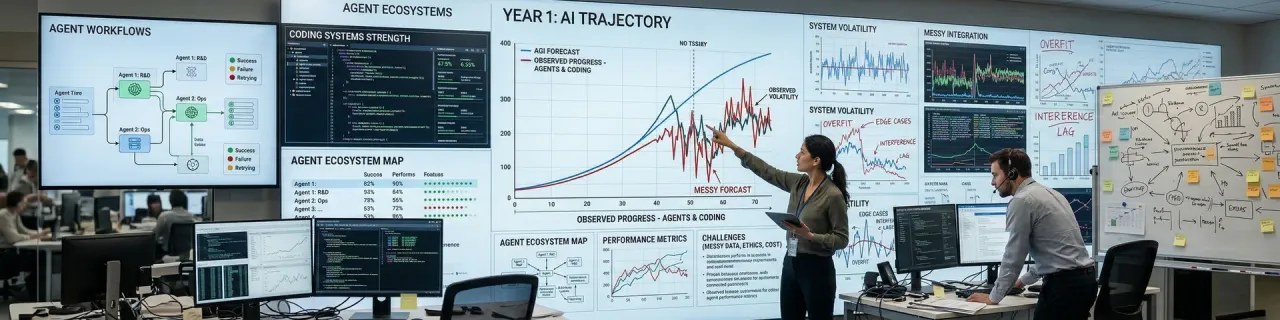
A year on, the AI 2027 forecasters graded their own predictions at 58–66% of pace. Agents and autonomous coding arrived; the AGI runway looks messier.
Last year, a report called AI 2027 tried to do something most AI commentary avoids.
It made a concrete forecast.
Released in April 2025 by a team of AI researchers and forecasters associated with the AI Futures Project, and willing to put numbers, timing, and mechanisms on the table, it was trying to sketch a plausible near-future: agents arriving, coding systems becoming materially more autonomous, labs pouring absurd money into compute, and the road to AGI starting to look less theoretical and more operational.
That is exactly why it is worth revisiting.
Most technology forecasting is designed to sound clever without ever being specific enough to fail. AI 2027 was specific enough to be wrong. A year on, we have enough evidence to do something rare in AI commentary.
Let’s see how they did.
What AI 2027 clearly got right
The easiest win for the forecasters is the broad shape of the market.Agents did arrive, and they arrived in the familiar way big new AI features now tend to arrive: the demos were smooth, the promo videos were slick, and the reality was lumpy. If you used these systems seriously this year, that was the texture of it — impressive demos, genuine workflow wins, and just enough unreliability to stop anyone sensible handing over the keys.
Consumer-facing “personal assistant” agents existed, but they did not instantly become mainstream behaviour. That part of the scenario looks solid. The idea was right. The daily habit change was slower. The fuller version of that idea — when every device can think — is still further out than the forecast implied.
That pattern is familiar because it happens all the time in business technology. The first question is rarely whether the product can do something. The real question is whether ordinary people trust it enough to use it repeatedly when the task matters.
On that front, the forecast was pretty good.
The same goes for coding agents. The qualitative call was that AI would become less like a helpful autocomplete engine and more like a junior employee you could point at a task. That also looks broadly right. The tooling changed. Expectations changed. The boundary between assistant and agent blurred quickly.
You stop asking for snippets and start delegating bounded chunks of work. You still hold the project and the judgement, but the machine now takes on pieces of real work.
The forecast also seems to have captured the economics of the race reasonably well. Companies kept spending. Compute remained central. The field did not settle into a calm platform market. It kept behaving like an arms race with glossy launch posts attached. That sustained spending is also why I don’t think this is a bubble — agents changed the compute equation permanently.
And perhaps most importantly, AI 2027 got the mood right. The industry does feel like it is moving from toy demonstrations to operational capability. Even when the details are off, that directional call has held up.
Where it was too aggressive
The biggest miss is pace.The authors’ own later grading says progress on the quantitative metrics was running at roughly 58 to 66 per cent of the pace implied by the original scenario, with some alternative aggregation methods producing slightly higher figures. However you slice it, the same conclusion appears: reality has been slower than the clean version of the story.
That is not a trivial miss. It changes the whole emotional register of the forecast.
A scenario that says this is coming very fast creates a different response from one that says it is still coming, but through delays, drag, and uneven capability gains. One feels like a sprint. The other feels like a prolonged industrial build-out.
The forecast seems to have overestimated how neatly a few curves would keep compounding in public. Benchmark progress, especially on some software engineering measures, has been less tidy than enthusiasts expected. The most important capabilities are still improving, but not every chart wants to cooperate.
When people talk about forecasting errors, they often imagine binary failure: either the future happened or it did not. Real misses are usually more annoying than that. The direction is right. The mechanism is visible. The timing is off just enough to change decisions.
That, to me, is what happened here.
The benchmark problem
One of the sharper reality checks came from software engineering benchmarks. Their own follow-up grading notes that progress on SWE-bench Verified was slower than AI 2027 expected. That matters, not because one benchmark rules the world, but because software engineering is one of the areas where AI progress has looked most commercially meaningful.If even that domain produces bumpier, slower gains than the neat forecast assumed, you should be cautious about every polished chart that turns today’s momentum into tomorrow’s inevitability.
Benchmarks still matter, but organisations buy workflows, reliability and confidence, not benchmark scores in isolation.
The real question is not only whether a model is smarter on paper. It is whether the surrounding system is dependable enough to change how work gets organised.
What the forecast understood better than its critics
A lot of criticism aimed at fast AI forecasts assumes that any error in timing discredits the whole exercise.I do not think that is right.
If you read AI 2027 as a calendar prediction carved in stone, of course it looks overconfident. If you read it as a structured attempt to force concreteness into a debate full of hand-waving, it looks much more valuable.
The piece made itself falsifiable. It said, in effect, here is what we think the path looks like; come back and check. That is far more useful than the endless genre of AI commentary that manages to sound dramatic while predicting almost nothing testable.
There is also a second thing it got right: progress is not just about smarter chatbots. The serious story is still about AI being folded into research, coding, operations and strategic advantage. In other words, the important shift is not consumer novelty. It is production capacity.
On that point, it has held up rather well.
What it missed about adoption
Where I think the fast-timeline crowd still tends to underweight reality is the messiness between technical capability and normal use.Working systems do not spread through society at benchmark speed. They spread through trust, habit, procurement, governance, budget cycles, integration headaches, user confusion and the sheer friction of changing routine.
A model can be astonishing and still fail to alter day-to-day behaviour at the speed a forecast assumes. We have seen that before with analytics, automation, mobile apps, cloud systems and just about every supposedly obvious next step in business technology.
The feature arrives first. The management adaptation arrives later.
This matters because readers often hear an AGI-adjacent forecast and translate it into “my business will be transformed in the next six months”. Usually that is the wrong translation. The nearer-term truth is more practical. Specific teams get leverage first. Certain workflows compress. Expectations shift. Then organisations slowly reorganise around what turned out to be real.
The long-term story may still be dramatic. The short-term experience is usually patchy.
What this means now
Three things stand out.-
Do not dismiss a forecast just because the timing is off. The best forecasts are often early in some places and late in others. What matters is whether they identified the right moving parts.
-
Do not confuse visible capability with smooth adoption. AI can be commercially important well before it feels socially normal.
-
And keep rewarding people who make concrete predictions and then revisit them in public. We need more of that habit, not less.
Most technology commentary is built to sound clever in the moment. Very little of it is built to survive contact with a calendar.
AI 2027 at least had the courage to leave marks on the wall.
A year later, the verdict looks something like this: the authors saw the direction of travel, understood the strategic logic, and caught the arrival of agents and operational AI better than many sceptics did. But they told the story as if the road would be cleaner than reality tends to allow.
If you are trying to make sense of AI now, the practical lesson is simple enough. Watch what changes work before you obsess over what changes civilisation. In most businesses, the management mess arrives well before the prophecy does.