The AI-Shaped Organisation
Companies adding AI to old structures fail. Learn why organisations must be redesigned around AI—not just enabled by it—to gain exponential advantage.
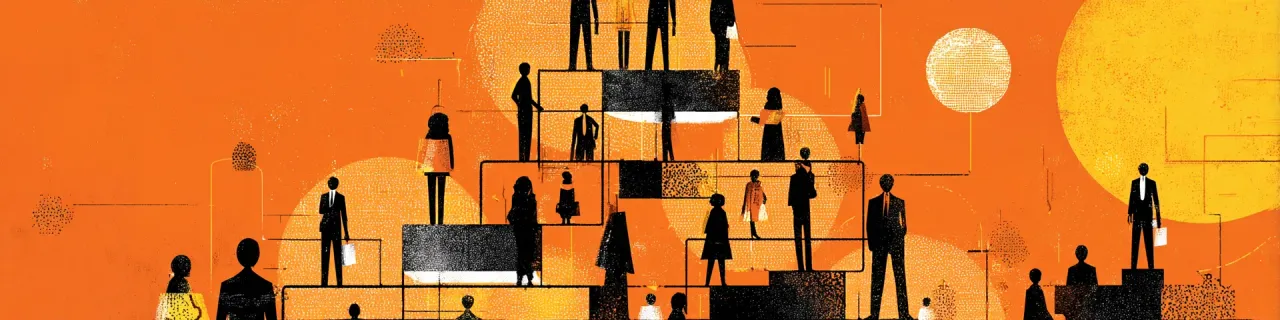
Why the next decade belongs to companies redesigned around machines that do the predictable work
There's a quiet mistake almost every business is making with AI, and it's so widespread it barely registers as a mistake at all.
They're trying to add AI to an organisation that was never designed for it.
AI is dropped into existing teams, wrapped around today's processes, grafted onto legacy systems and expected to produce transformation. It never quite does. You get productivity bumps, novelty, and a handful of impressive demos — but nothing that fundamentally changes how the organisation works.
The reason is simple: AI isn't a tool you adopt.
It's a force that reshapes the organisation around it.
And if the structure doesn't change, the benefits don't land.
We still run "human-shaped" organisations
Nearly every feature of modern business was built for the constraints of human workers. We have hierarchies because humans can't coordinate themselves at scale. We have standard processes because humans forget steps, meetings because they lose alignment, and departments because they specialise and struggle with context switching. We have status reports because humans can't observe everything happening in the system.
None of this is wrong. It just reflects the realities of a pre-AI world.
It's the organisational equivalent of designing cities around horses.
But the moment machines can reliably handle the predictable parts of work — routing, coordination, compliance checks, information flow, summarising, reporting, triage — the logic of the organisation changes.
The business is no longer constrained by human limitations.
And yet, almost every organisation still behaves as if it is.
What changes when AI does the predictable work by default
When AI becomes the execution layer — the part of the system that moves information, keeps state, hands off tasks, and performs the routine "work about the work" — something subtle but profound happens:
Humans stop being the system's bottleneck.
In most companies, humans are the glue: the coordinators, schedulers, notifiers, checkers, nudgers, trackers, escalators, and interpreters. The invisible scaffolding of the organisation is held together by people doing micro-tasks they don't even recognise as tasks.
AI dissolves that scaffolding.
What remains is work that is inherently human: judgment, creativity, negotiation, problem-solving, leadership, empathy, and the ability to make sense of ambiguous situations.
But to unlock that shift, the shape of the organisation has to change.
The new shape of the organisation
Picture a business no longer built around departments, handoffs, and process maps, but around two complementary layers:
1. The Human Layer — deciding, interpreting, solving
People focus on:
- making judgments
- designing strategy
- building relationships
- creating new ideas
- resolving ambiguity
- shaping outcomes
This layer becomes smaller, more cross-functional, and more skilled.
2. The AI Execution Layer — doing the predictable work
This isn't a "department" — it's an operational substrate running across the whole organisation.
It handles:
- coordination
- triage
- data movement
- summarisation
- compliance checks
- repeatable workflows
- status and state-keeping
Everything humans used to do because nobody else could, AI now does faster, more consistently, and without fatigue.
Rather than supporting the existing structure, this layer reshapes it.
The business becomes flatter, more fluid, more information-rich, and far less dependent on human glue.
The boundary between roles changes.
The definition of "productive work" changes.
The rhythm of the organisation changes.
This is not automation plugged into a legacy structure — it is a structure rebuilt around the assumption of automation.
Why bolt-on AI never works
Companies that simply "add AI" to their existing organisation eventually hit the same wall:
AI produces output, and humans still have to stitch the pieces together.
That's the problem.
The bottleneck isn't the thinking — it's the plumbing.
You can automate a task, but if the workflow around it is still defined by human constraints, the value leaks away. Teams keep meeting. Managers keep chasing updates. The organisation keeps moving at human speed, because its shape is still human-shaped.
AI doesn't fail — the structure does.
This isn't about replacing people
It's about replacing the parts of the system that only exist because humans had limitations.
The moment those limitations disappear, the organisation can evolve.
Humans become more valuable when the work around them is redesigned.
Not replaced — redeployed into the 20% of work where they deliver 80% of the value.
The companies that understand this will outperform the ones that don't, and the gap will widen quickly. Not because they "use more AI", but because their very design amplifies human strengths rather than patching over human weaknesses.
The next competitive advantage
Most organisations today fall into one of two categories:
AI-enabled:
They use AI tools, run pilots, automate tasks, run workshops, and celebrate productivity gains.
AI-shaped:
They redesign the organisation around the assumption that machines do the predictable work — and humans do the valuable work.
AI-enabled companies get incremental improvements.
AI-shaped companies get exponential ones.
This is largely aspirational — few if any companies have fully made this leap yet. But we're entering the decade where the difference will become impossible to ignore. The question isn't whether this transformation will happen, but which companies will be early enough to compound the advantage.