Scaling without hiring: leverage density and the new economics of growth
AI lets small firms scale output without adding headcount. But scaling decisions without scaling governance creates drift. Here is the design problem.

Part 7 of The E-Myth, revisited again
The previous article in this series ended with a question that sounds like an opportunity but is actually a warning: what happens when you scale decision-making without scaling accountability?
That question is worth sitting with, because the obvious answer — don't do that — is exactly what most AI-enabled firms are doing right now. They're scaling output, celebrating the efficiency gains, and assuming governance will keep up. It won't. Not automatically. Not without design.
This is the seventh article in a series that reexamines Michael Gerber's The E-Myth Revisited for an era when the fundamental constraint on business growth is no longer the supply of people. The first article established why the E-Myth's core insight — work on the business, not in it — remains sound even as its assumptions about labour substitution break down. Since then, we've worked through capability maps, policy-driven autonomy, bounded intelligence specifications, and the strategic question of where judgement belongs. All of that was groundwork. Now we need to talk about what happens when you actually use it to grow.
The assumption: growth means hiring
Gerber's franchise model was, at its core, a scaling model. Design the system once. Document the procedures. Replicate through people. More customers meant more staff. More complexity meant more managers. More locations meant more of everything. Revenue scaled with headcount, and the founder's job was to build systems that made headcount productive.
This made perfect sense when every role in the business required a human being to fill it. The constraint on growth was always the supply, training, and management of people. Hiring was slow. Training was expensive. Management was the overhead you accepted in exchange for getting bigger. And the entire E-Myth framework — the procedures, the operations manuals, the franchise prototype — existed to make that overhead manageable.
The economics were roughly linear. Double the clients, roughly double the staff, roughly double the costs. Margins stayed relatively flat because revenue and labour costs moved together. You could improve the ratio through better systems, better training, more efficient processes — but the fundamental relationship between output and headcount held. Growth was a people problem, and the E-Myth solved it as a people problem.
Where it breaks
AI decouples output from headcount in ways the franchise model never anticipated.
A three-person consultancy can now produce the research, analysis, and client deliverables that previously required twelve. A solo founder can operate customer service, content production, and financial reporting functions that once needed dedicated staff. The relationship between revenue and headcount that defined business economics for decades is becoming unreliable — not for every function, but for enough of them to fundamentally change the growth equation.
To make this concrete: think about a marketing agency with five people that currently produces forty pieces of content per week across fifteen client accounts, with AI drafting and human review. The AI systems could produce a hundred and twenty pieces without breaking a sweat. The same reporting tools that generate dashboards for fifteen clients could generate them for forty-five. If a growth opportunity arrived tomorrow — triple the client volume — the technology could handle it.
The question is whether the firm could handle it. And the answer is more complicated than the technology makes it look.
Because when a firm adds headcount, the new hires bring their own judgement. They ask questions. They raise concerns. They push back on bad decisions. They notice when something feels wrong. Managers review work, provide feedback, catch drift. The very friction of managing people — the thing every founder complains about — provides a kind of quality control that nobody designed and nobody appreciates until it's gone.
When a firm scales through AI leverage, none of that happens automatically. The system gets more capable without getting more careful. Output increases while oversight stays flat. And the founder, pleased with the efficiency gains, doesn't notice the gap until a client points out that something has gone quietly wrong.
Leverage density: the replacement metric
The E-Myth measured growth in headcount and locations. An AI-first business needs a different metric. I think of it as leverage density: the ratio of output to the number of human decision-points required to keep that output safe and aligned.
This is not the same as automation. Automation replaces human labour with machine labour. Leverage density replaces human decision-making with bounded intelligence — AI systems that operate within defined constraints, governed by policies rather than procedures, placed deliberately based on specifiability and risk. The human contribution shifts from doing to overseeing, designing, and intervening.
A high-leverage-density firm produces disproportionate output relative to its human headcount because its bounded intelligence roles handle the volume while humans handle the exceptions, the ambiguity, and the governance. Gerber's franchise prototype achieved a kind of leverage — procedures allowed less-skilled employees to perform at a consistent level. But that leverage was always constrained by the fact that every role still required a human being. AI removes that constraint for many roles, and when it does, the incremental cost of additional output drops toward zero while the incremental cost of ensuring that output is correct, aligned, and appropriate does not.
That gap — between what the system can produce and what the humans can govern — is where the interesting problems live.
The governance gap
Return to the marketing agency. At forty pieces of content per week, the two human reviewers can give each piece meaningful attention. They catch about fifteen per cent that need revision. They know the clients well enough to sense when something is technically correct but tonally wrong. They flag patterns — this client's audience responds badly to that kind of phrasing, that client's brand guidelines have drifted since the original brief.
Now scale to a hundred and twenty pieces per week. The AI produces them just as easily. But the two reviewers are now seeing three times the volume. Would the catch rate hold? Almost certainly not — not because they're less capable, but because attention is finite. The specification hasn't changed. The governance capacity has degraded. The system is producing more while the humans are overseeing less, and the distance between those two curves is the governance gap.
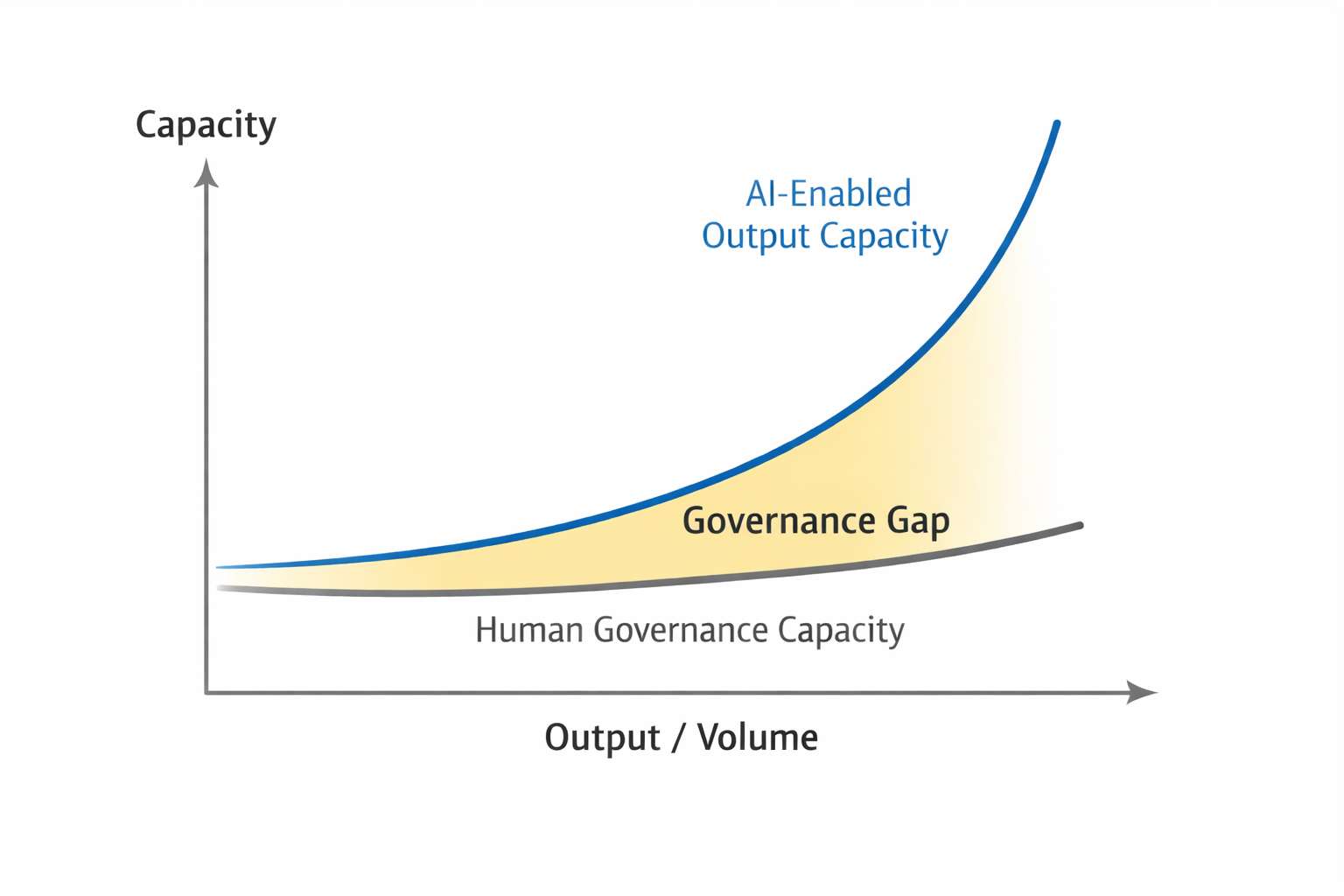
This gap has no analogue in Gerber's world. When you added human headcount, you implicitly added governance. It arrived unannounced, embedded in the people themselves. New employees asked questions. They raised concerns. They brought fresh eyes to established patterns. The very act of onboarding someone forced you to articulate assumptions you'd stopped examining. None of this was designed — it was an emergent property of having humans in the system.
AI leverage doesn't produce that emergent property. Nobody questions the system's assumptions because the system doesn't have questions. Nobody notices drift because the system operates consistently — which is precisely the problem when the consistent output is consistently wrong in ways that are subtle enough to miss.
The signals that a firm has scaled past its governance capacity are easy to overlook, because the system is still producing output, still meeting quantitative metrics, still "working." Errors are discovered by clients rather than internal review. Escalation triggers fire so frequently that humans start approving them without adequate consideration — alert fatigue turning a safety mechanism into a rubber stamp. Or, conversely, escalation triggers rarely fire despite increasing volume, suggesting the specification is too permissive or the edge cases aren't being caught. Nobody can explain why the system made a particular decision when questioned. The policies that govern the system haven't been reviewed or updated in months despite changing conditions.
The subtlest signal is the hardest to detect: output quality metrics look fine, but qualitative assessment reveals drift. The content is technically correct but somehow off. The client reports contain accurate numbers but miss the narrative. The customer service responses resolve the ticket but leave the customer feeling unheard.
This failure mode is not breakdown. It's drift. And drift is the natural consequence of scaling output faster than you scale the human capacity to keep that output honest.
Where leverage is safe — and where it isn't
Not all functions carry equal risk when you scale them, and the placement framework from the previous article provides the basis for understanding the difference.
Leverage is safest where the role has high specifiability — a well-defined bounded intelligence specification with clear decision authority, explicit constraints, and known failure modes. Where the stakes per decision are low and errors are recoverable. Where the pattern is stable and the criteria don't change frequently. Where graceful degradation is designed in. Reporting and analytics typically fall here — the same system that serves fifteen clients can serve forty-five with minimal additional governance overhead, provided the templates and data connections are sound.
Leverage is riskiest where the role has medium specifiability with hidden edge cases. Where the stakes compound — each individual error is small but they accumulate. Where the context changes faster than the specification is updated. Where success requires tacit knowledge that erodes when humans stop doing the work — the skill atrophy problem explored in Article 6.
The dangerous middle ground catches most firms. A customer service function that handles routine enquiries well may fail catastrophically when a novel situation arises that the specification doesn't cover — and at scale, novel situations arrive more frequently simply because volume increases the probability of encountering edge cases. A content pipeline that maintains quality at ten pieces per week may drift at a hundred because the human reviewers can no longer give each piece adequate attention.
The pattern is consistent: functions that look safe at low volume become risky at high volume, not because the specification changed but because the governance capacity didn't scale with the output. The governance gap is not a fixed property of the system — it's a function of volume. And volume is exactly what AI leverage is designed to increase.
When not to scale
Here is the argument that will strike some readers as counterintuitive: sometimes the right answer is to leave capacity on the table.
Not every function should be scaled to its maximum AI-enabled output. The E-Myth taught founders that the goal was scalable systems — build once, replicate infinitely. In an AI-first world, the goal is appropriately scaled systems: systems designed to handle the volume they can handle well, with deliberate limits where scaling would compromise quality, alignment, or accountability.
When the firm's competitive advantage depends on human attention that doesn't scale — the consultancy whose value proposition is senior partner involvement in every engagement, for example — scaling through AI leverage undermines the very thing that makes clients choose you. When the governance overhead of scaling exceeds the marginal revenue — you could handle twice the clients, but the oversight required would consume all the additional margin — the economics don't support it even though the technology does. When scaling would erode the trust relationships that generate business — clients chose you because of the human touch, and removing it removes the reason they're there.
There's also the learning loop to consider. The deliberate inefficiency argument from Article 6 applies directly to growth decisions. The founder who personally reads customer complaints stays connected to operational reality. The account manager who spends "excessive" time on calls catches early warning signs. These inefficiencies are information channels. Scale them away and you lose the signals that tell you when assumptions need updating.
And sometimes the honest assessment is simply that the system's bounded intelligence specifications aren't mature enough to handle increased volume safely. The specification works at current scale, but it hasn't been tested at three times the volume. Scaling before the specifications are ready is how firms discover their governance gap the hard way — through client complaints, quality failures, or quiet reputational erosion.
What this looks like: the agency scales up
Return to the agency with its growth opportunity — fifteen accounts to forty-five. We've already seen that content review breaks at triple volume. But the scaling decision isn't a single yes-or-no question. It's a function-by-function design problem.
Content generation can scale, but the constraint is review capacity, not production capacity. The agency could scale to eighty pieces with the same review rigour — each reviewer handling forty. It could scale to a hundred and twenty with reduced review, moving from full assessment to spot-checking. Or it could hire an additional reviewer. Each option has different leverage density implications. Eighty pieces with full review preserves quality but leaves revenue on the table. A hundred and twenty with spot-checking risks drift. An additional hire is traditional scaling, but targeted at the specific governance bottleneck rather than adding headcount across the board.
Client relationship management presents a different challenge entirely. Scaling to forty-five accounts is not primarily an AI problem — it requires human relationship capacity. AI can handle more logistics: scheduling, status updates, routine communication. But the human judgement that makes relationships work — sensing when a client is unhappy before they say so, knowing when to push back on a brief and when to accommodate — doesn't scale linearly. The options are to hire account managers, segment clients by service tier so that some get human-primary attention and others get a hybrid model, or accept that twenty-five to thirty accounts is the appropriate ceiling for current governance capacity.
Reporting and analytics is the function that scales most cleanly. AI-generated with human verification for client-facing reports, this is high-specifiability, low-stakes work. The same system can generate reports for fifteen or forty-five clients with minimal additional governance overhead, provided the templates and data connections are sound. This is where leverage density is highest and safest.
The overall picture is not "three times the clients with the same team." It's something more nuanced — perhaps twice the clients with one additional hire focused on the governance bottleneck in quality review, a tiered service model for client relationships, and aggressive AI scaling for content production and reporting. Some functions scale aggressively. Others scale modestly. Others don't scale at all because scaling them would compromise the thing that makes them valuable.
The leverage density is real but uneven. The firm is meaningfully larger in output than its headcount suggests, but it scaled deliberately rather than uniformly. And the founder's role in this process was not to maximise output but to design the scaling plan — function by function, asking not "how much can AI handle?" but "how much can we govern?"
Designing for leverage density
The practical framework for scaling decisions starts with the capability map from Article 3. For each function, the questions are straightforward even if the answers are not.
What is the current volume, and what volume could AI leverage enable? What governance is required at current volume, and what would be required at scaled volume? Does the firm have the human capacity to provide that governance? What would be the consequences of a governance failure at scaled volume — a missed error in a client report versus a compliance violation versus a reputational incident? Is the bounded intelligence specification mature enough for the increased volume? Does the placement decision still hold at higher volume, or does increased volume shift the risk profile enough to warrant a different arrangement?
The answers produce a scaling plan that is function-by-function, not organisation-wide. Some functions scale aggressively — routine content, standard reporting, basic customer enquiries. Others scale modestly — quality review, account management. Others don't scale at all — strategic decisions, trust-building interactions, crisis response.
This is the leverage density approach: scale each function to its appropriate level based on the governance available, not to its maximum possible output. The result is a firm that operates at higher output than its headcount suggests but not at higher output than its governance supports.
The small firm advantage — and its ceiling
The structural advantage that AI leverage creates for small firms is genuine. Fewer management layers. Less coordination overhead. Faster decision-making. Lower fixed costs. A five-person firm that designs its bounded intelligence roles well can compete on output with organisations many times its size, without the bureaucratic drag that makes larger firms slow and expensive.
But this advantage has limits that are worth acknowledging honestly.
It applies primarily to roles that can be specified as bounded intelligence — the execution and coordination layers identified in Article 2, not the design layer. The strategic thinking, the creative direction, the relationship judgement that sits at the top of the capability map doesn't scale through AI leverage. It scales through human capability, which means it scales slowly or not at all.
It depends entirely on the founder's ability to design and govern the system. The entrepreneur capability — setting objectives, defining constraints, encoding intent — is what makes leverage density possible. A founder who can't do this work, or who is too busy doing operational work to focus on it, won't achieve the leverage regardless of how good the tools are.
It creates vulnerability to single points of failure. Fewer humans means less redundancy in judgement. If the one person who understands the client relationship is unavailable, or the one reviewer who catches subtle quality issues leaves, the system has no buffer. The very leanness that makes small firms efficient makes them fragile in ways that larger firms with more people are not.
And it can create a ceiling. The firm can produce more output, serve more clients, generate more revenue — but it cannot grow its governance capacity without eventually adding human capability. At some point, the constraint is not what the AI can produce but what the humans can oversee. And that point arrives sooner than most founders expect.
The opportunity is real but not unlimited. Small firms can now operate at scales that were previously impossible. They cannot operate at those scales without the governance structures that make scaling safe. The lever is longer, but someone still has to hold it.
The takeaway
The E-Myth's growth model was built for an era when every role needed a human and every expansion required hiring. That era is ending for many functions, and the firms that understand leverage density will build something Gerber never quite imagined: businesses that are larger in output than they are in headcount, not through reckless automation but through deliberate design.
The discipline required is not to scale as much as possible but to scale as much as is safe — function by function, with governance capacity as the binding constraint rather than technology capability. The firms that get this right will occupy a competitive space that didn't previously exist: too capable to be called small, too lean to be called large, and too deliberately designed to be called lucky.
But scaling creates the conditions for drift. More decisions, less oversight per decision. A wider governance gap that grows quietly even in well-designed systems. The question that follows naturally from leverage density is not how to scale further but how to maintain alignment over time. Who is responsible when a system of bounded intelligence roles produces an outcome that nobody individually decided? How do you detect drift before it becomes failure? What does accountability look like when the work is done by a system rather than a person?
That is where the next article will go.