When revenue grows, here's what quietly breaks first
Growth doesn't kill small businesses on a bad idea. It exposes operational debt — and it breaks in a predictable order. Here's how to get ahead of it.

There's a particular kind of bad month that only arrives when things are going well. Revenue is up — the best quarter you've had — and yet you're working later than you did when the business was half this size. A good customer got let down last week and you found out by accident. Two jobs are sitting in a state nobody can quite explain. You're answering emails at eleven at night, not because the work is hard, but because you're the only one who knows how half of it actually gets done.
If any of that sounds familiar, the problem isn't your idea. It rarely is. Most small businesses that come unstuck don't do it on a weak strategy or a bad product — they do it on the operational debt that growth calls in. The business that worked beautifully at five people was held together by things you couldn't see and didn't have to think about: you, mostly. Growth doesn't break those things gently. It exposes them.
What's worth understanding is that the debt doesn't all come due at once. It breaks in an order. The same joints give way, in roughly the same sequence, in business after business — and almost always a size or two later than the owner expected, which is exactly why it catches people out. If you know the order, you can shore up each weakness before you reach it rather than after it's already cost you a customer. That's the whole game: getting ahead of the sequence instead of being ambushed by it.
It's not a glamorous game. The World Economic Forum looked at more than 200 start-ups this spring and concluded that what limits growth is rarely the technology or the idea. It's organisational readiness, the dull plumbing of how a business actually runs. Founder Reports, asking owners directly, found the same thing from the other end: the most common mistake when revenue climbs is trying to scale without building the systems to carry it. None of it makes a good origin story. It's just what breaks first.
The first thing to go is you
The first joint to give way is the owner. Not dramatically — you don't fall over. You become the bottleneck without noticing, because at small size being the bottleneck is indistinguishable from being good at your job.
When there are five of you, the fact that everything passes through you is a feature. You know every customer, every job, every awkward exception. You hold the standard in your head and apply it personally. Decisions are quick because there's one decider and it's you, and you're usually right. This is the happiest a business ever feels. What comes next can feel like something going wrong, when really it's a sign you've grown.
But that arrangement has a ceiling, and you hit it before you can see it. At some volume there are simply more decisions, more exceptions and more customers than one person can hold in their head while also doing the work. You don't notice the ceiling as a wall. You notice it as fatigue, as small things slipping, as a nagging sense that you're busier than the revenue justifies. Michael Gerber called this the technician trap decades ago, and it hasn't gone anywhere. If anything, capable owners hit it harder, because competence lets you carry the whole business on your back for longer before your knees buckle.
This is fixable, but only before the buckling — and it's a job of triage more than delegation. Sit down and separate the handful of things only you can do — the relationships, the judgement calls, the standard-setting — from the much larger pile of things you do because you always have. The second pile is what you start handing over while you still have the time and goodwill to teach it properly. Hand it over late, in a crisis, and you'll train badly and resent it. For a fuller version of this argument, I've written before about what “working on the business” really demands of an owner.
Then the handoffs stop working
The next thing to break is the way work moves between people — and it breaks precisely because the first fix worked. You've started handing things over. Good. But at small size, handoffs happen by tapping someone on the shoulder. You ask Sarah to sort the thing, Sarah knows what “the thing” means because she was in the room when it came up, and it gets done. Nobody writes anything down because nobody needs to. The whole company fits inside a single conversation.
Add a few more people and that conversation fractures. Sarah wasn't part of that conversation this time. The new starter doesn't know that this client always wants the extra check, because that knowledge lived in your head and you forgot to say it out loud. Things don't fail loudly here; they fall into the gaps between people. A job gets done twice, or not at all. Two people each assume the other has it. The work that used to move on a shoulder-tap now needs a system, and you haven't built one because, until last month, you didn't.
The remedy is duller than it sounds and more valuable than it looks: write down how the handful of things that happen over and over actually get done. Not a thousand-page manual — nobody reads those, and you don't have time to write one. Just the recurring jobs, captured in enough detail that someone who wasn't there at the time can pick them up. Tribal knowledge feels efficient right up to the day the tribe gets too big to all sit at one table.
The quality you used to guarantee personally starts to drift
Owners find this stage the most unsettling of all, because it touches the thing they're proudest of. At small size, quality was guaranteed by you. Everything that went out the door passed under your eye, and your eye was the standard. You didn't need a definition of “good” — you were the definition.
When more hands do the work, “good” stops being a person and has to become a thing you can point at. If you've never made the standard explicit, every new person ends up inventing their own version of it, calibrated to their own taste and their read of what you'll tolerate. The drift is gradual and almost invisible from the inside. You start to see the same mistakes corrected twice, the odd job sent back, a long-standing customer asking why this one wasn't up to your usual. No single piece is bad enough to alarm you. It's the average that slides. Then a customer who's been with you for years notices something that, frankly, you'd never have let leave the building two years ago. The gap between what you intended and what your business now actually does is suddenly sitting in your inbox.
The work here isn't to inspect everything yourself again; that just turns you back into the bottleneck you escaped two stages ago. It's to define the standard so that it can live outside your head — what good looks like, what's non-negotiable, what a finished job has to contain before anyone considers it done. A task tells someone what to do. A standard tells them when they've done it well enough.
Then the cash gets strange
This is the stage that surprises people, because it arrives wearing a disguise. The numbers are up. Sales are up, the order book is fuller than it's ever been, profit on paper looks healthy. And yet there's a fortnight every month where the account is uncomfortably thin and you're not entirely sure why.
The reason is that growth eats cash before it pays you back. You take on a bigger job, so you buy materials and put people on it now, but you don't get paid until it's delivered and the invoice clears thirty or sixty days later. Multiply that across more and bigger jobs all running at once and you can be more profitable and more short of cash in the same quarter — a combination that feels like a paradox until it's nearly closed you. The bookkeeping that told you the truth at small size, where money in roughly tracked work done, stops being a reliable narrator the moment there's a long gap between doing the work and being paid for it.
Getting ahead of this means forecasting cash, since profit alone won't warn you in time. You need a rough, forward-looking view of what's coming in and going out over the next few months, so that a great month doesn't set up a frightening one. It doesn't have to be sophisticated. A spreadsheet you actually look at beats an elegant model you don't. What matters is that you stop being surprised, because a cash surprise in a growing business is the one that does the real damage.
Last comes the hiring
By now the pressure has been building for a while, and most owners respond by hiring their way out of it. That instinct is sound. It's also where a lot of good businesses take on the weight that eventually slows them down, because hiring under pressure and hiring to a plan produce very different companies.
When you hire reactively — when each new person is a patch for whichever pain is loudest this week — you tend to hire a vague shape and hope it works itself out. You're so relieved to have another pair of hands that you don't define what they're actually for, and six months later you've got someone busy, expensive and not obviously moving the business forward. Worse, reactive hiring is how a company full of people who all row turns into a company carrying passengers: roles that exist to manage the complexity that other roles created. I've written about why a small business is more like a Viking ship than a cruise liner. The longship's advantage is that everyone pulls an oar, and you lose it one comfortable, reasonable-sounding hire at a time.
The way out is to hire to a plan, before a crisis forces your hand. Before you advertise, you should be able to say what this person owns, what good looks like in their hands, and how you'll know in ninety days whether it's working. If you can't write that down, you're not ready to hire — you're ready to feel better, which is a different and more expensive thing.
Getting ahead of the order
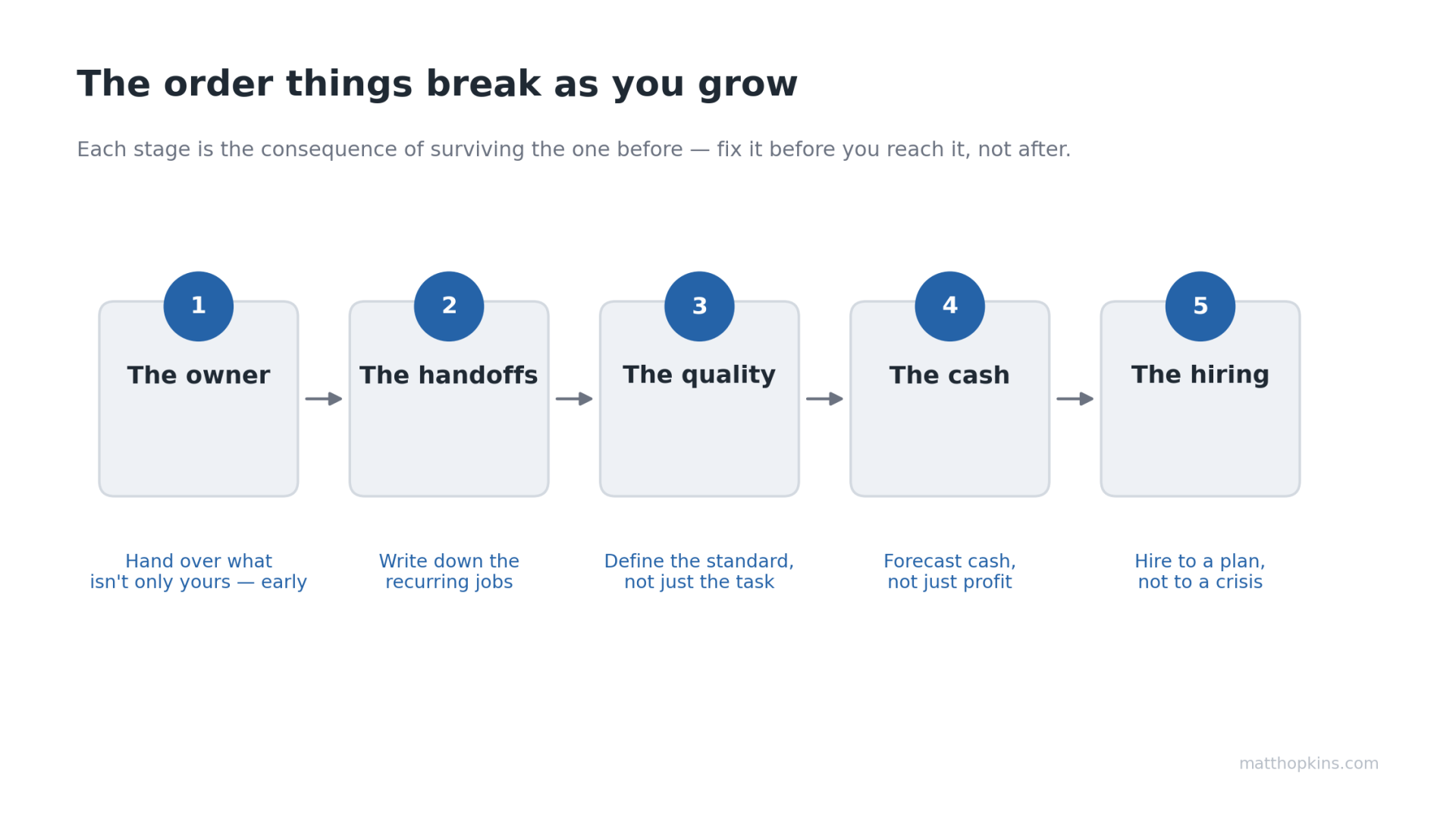
None of these failures is a sign you've done something wrong. They're a sign you've done something right and grown, which is what makes them so disorienting — success isn't supposed to feel like the wheels loosening. But they aren't random. The owner becomes the bottleneck, the handoffs fracture, the quality drifts, the cash gets strange, and the hiring goes reactive, in that order, because each stage is the consequence of having survived the one before it. The order isn't iron. I've seen cash bite first in businesses built on a few big contracts, and quality hold long after it should have slipped because the owner refused to let go. But it's a common enough pattern to plan around, and that's what makes it worth knowing.
So the owners who scale well aren't the ones who avoid all this. They're the ones who see it coming a size early and do the dull, unglamorous work of building the next stage before they're forced to. You don't have to fix it all at once — you just have to stay a move ahead of the sequence you can now see coming.