Y2K was a bug — AI is a system shock
Y2K had a deadline. AI doesn’t. The real challenge isn’t fixing a bug — it’s managing work that now moves faster than your controls.
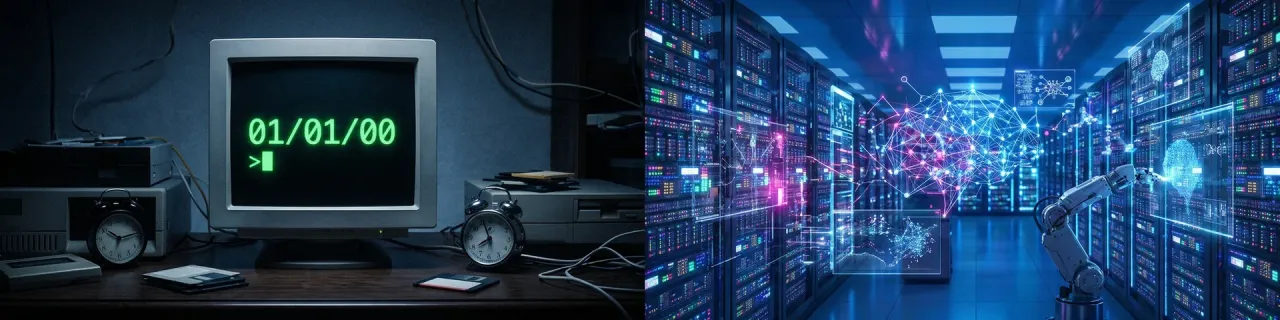
Someone will always say AI feels a bit like Y2K.
I get why.
Same low-level technical anxiety. Same consultants. Same sense that something important is happening somewhere beneath the surface, and ordinary business people are expected to care about it very quickly.
But it’s the wrong analogy.
Y2K was a bug. AI is a management problem.
That’s the difference.
Y2K had a finish line. AI doesn’t.
Y2K had a finish line. You found the systems that were going to break, fixed them, tested them, and got through the rollover. It was expensive, stressful and global, but it was still bounded.
AI isn’t.
There is no single defect to eliminate. No stable inventory. No moment where you can say, right, that’s sorted now.
The models change. The tools change. The interfaces change. The pricing changes. And, more importantly, the way people use the stuff changes. Usually faster than the business changes around it.
That’s the bit people miss.
The real risk isn’t that AI gets clever. It’s that work starts moving differently before anyone has decided how it should be managed.
The trouble starts when adoption outruns management
You can already see it.
A draft that used to take two days now appears in twenty minutes. Great. Except nobody has decided whether it’s a first draft, a final draft, or something in between.
A junior member of staff starts producing better work. Also great. Except now you can’t easily tell where their judgement ends and the model’s pattern-matching begins.
A team starts moving faster because handoffs disappear. Fine. Until an error slips through and nobody can work out who actually owned the decision.
That’s why Y2K isn’t the right frame.
Y2K was about remediation. AI is about control.
Not control in the paranoid sense. Just ordinary management control: who decides, who checks, what gets measured, what gets escalated, and what must never leave the building without a human signing it off.
The companies getting into trouble with AI usually aren’t doing anything reckless.
They’re doing something much more normal.
They’re letting adoption outrun management.
That’s how most operational mess happens. Not through stupidity. Through convenience.
Someone finds a quicker way to get decent output. Then someone else copies it. Then it becomes normal. Then six weeks later the business is relying on a process nobody really designed.
Sound familiar?
It should. That’s how shadow IT happened. It’s how spreadsheet risk happened. It’s how a lot of temporary business processes became permanent.
AI just accelerates the pattern.
And because the outputs look plausible, the slippage is harder to spot.
This is a workflow problem, not just a technology problem
That’s why so much of the public conversation around AI feels off to me. Too much of it is framed as a technology story.
It isn’t.
For most small businesses, this is a workflow story. A supervision story. A decision-making story. A quality-control story.
The model matters, obviously. But not as much as the operating routine around it.
That’s the real lesson.
If you run a small business, you do not need an enterprise AI governance framework. You do not need a steering committee, an ethics board and a twelve-layer approval process.
You need something simpler, and probably more useful.
If you’ve read my earlier piece on bounded intelligence and role design, it’s the same underlying point: scope, ownership and review matter more than the tool itself.
What to do this week
Pick two workflows where speed matters and mistakes are recoverable.
Decide what the AI can draft, what a human must approve, and what is off-limits.
Review the outputs every week.
Log the failures.
Tighten the process.
Repeat.
That’s it.
Not glamorous. Not futuristic. But it’s how you stop a helpful tool turning into an unmanaged dependency.
Here’s the catch.
Most of the value from AI won’t come from dramatic automation stories. It’ll come from small improvements in how work moves through the business: fewer delays, faster drafts, better summaries, quicker handoffs, less administrative drag.
Useful stuff.
But those gains only compound if somebody owns the system around them.
Otherwise you get the worst of both worlds: more speed, less clarity.
And that’s what many firms are drifting into now. They think they’re adopting AI, but what they’re actually doing is loosening management without meaning to.
The part worth borrowing from Y2K
Y2K didn’t do that.
Y2K forced discipline. Lists, testing, ownership, status reports, deadlines.
That discipline is the part worth borrowing.
Not the analogy.
The transferable lesson from Y2K is not don’t panic.
It’s this: systemic risk has to be managed systematically.
Back then, the question was whether the systems would keep working after midnight.
Now the question is whether your business still knows how decisions get made once AI is in the loop.
That’s a much messier problem.
It’s also the real one.