Deciding where judgement belongs
Takeaways from The E-Myth: how to decide where judgement belongs in your business, clarify roles, and build systems that actually work.

Part 6 of The E-Myth, revisited again
The previous article gave us the mechanics — a framework for defining any role with enough precision for delegation -- but knowing how to specify a role does not tell you what should fill it.
Which roles need human judgement? Which can be fully automated? Which must stay hybrid because the stakes are too high for autonomous operation? Which should remain deliberately inefficient because efficiency would destroy something valuable?
These are design problems, not optimisation problems.
The E-Myth assumption about filling roles
Gerber assumed that once you had documented your systems and defined your roles, the question of who fills them was primarily a hiring problem. Find the right people, train them properly, and the system runs. This made sense when all roles were filled by humans and the challenge was getting people to follow procedures consistently.
AI changes the terms. The bounded intelligence framework makes it possible to define any role precisely enough for delegation. But "possible to specify" is not the same as "should delegate to AI." Some roles require judgement that loses its value when fully specified. Some carry stakes where autonomous operation creates unacceptable risk. Some could be made efficient but should not be.
The question shifts from "can this role be filled by AI?" to "should it be?"
Three types of judgement
The word "judgement" covers too much ground.
Routine judgement follows patterns and applies clear criteria. AI often handles it better than humans — no fatigue, no inconsistency. Invoice processing, data entry, format checking.
Expert judgement requires pattern recognition across complex situations. The account manager sensing a souring relationship is recognising signals they may not yet have articulated. It can sometimes be partially specified, but a tacit component always resists capture. Customer service, content creation, quality review live here.
Value judgement involves weighing incommensurable goods or interpreting organisational intent in novel situations. It cannot be specified because it requires ongoing interpretation of what the organisation cares about. Strategic decisions, creative direction, crisis response.
The placement question starts with judgement type. But two other dimensions matter: stakes and the strategic value of inefficiency.
Stakes
Even when a role is specifiable, stakes affect placement. A content review AI that approves off-brand content creates a small problem. A legal review AI that approves content with liability exposure creates a large one. Same precision, different placement.
High-frequency, low-stakes decisions can tolerate autonomous operation — errors are recoverable. Low-frequency, high-stakes decisions require human involvement — errors compound or cannot be undone.
Deliberate inefficiency
You should also consider that some roles should remain inefficient because the inefficiency serves a purpose.
The client relationship manager spends what looks like excessive time on calls. An efficiency analysis flags this as waste. But the "inefficient" conversation is where the client mentions, almost as an aside, that they are thinking about expanding into a new market. That aside becomes a major opportunity.
The founder personally responds to customer complaints despite having staff who could handle them. The inefficiency keeps them connected to operational reality in ways dashboards cannot replicate.
Efficiency creates its own failure modes. When humans stop doing work, they stop learning from it. When communication becomes efficient, it often becomes less honest. When interactions feel automated, relationships weaken. Trust requires inefficiency: the signal that someone chose to spend time when they did not have to.
Placing judgement
Judgement placement emerges from the interaction of three forces: the type of judgement involved, the stakes of getting it wrong, and whether inefficiency itself carries strategic value.
Routine judgement with low stakes is the simplest case. These decisions follow clear rules, errors are cheap, and volume matters more than nuance. Full automation is usually appropriate, and human involvement adds little beyond reassurance.
When routine judgement carries high stakes, the calculus changes. The logic may still be specifiable, but the cost of error justifies human oversight. In these cases, AI provides speed and consistency, while humans act as a safety net — reviewing edge cases, handling exceptions, and retaining ultimate accountability.
Expert judgement introduces ambiguity. At low stakes, AI can take on much of the volume, with humans stepping in where signals are unclear or outcomes matter more. Oversight can be loose because mistakes are recoverable and learning is continuous.
At high stakes, expert judgement requires more deliberate boundary-setting. AI can handle coordination, analysis, and preparation, but humans must own the final calls. Escalation paths need to be explicit, not improvised, otherwise responsibility diffuses and judgement quality erodes over time.
Value judgement sits apart. Because it involves interpreting organisational intent rather than applying criteria, it cannot be meaningfully delegated. AI can inform, simulate, or challenge, but humans must remain primary decision-makers regardless of stakes.
There is one overriding exception to all of this: roles where inefficiency is itself a source of value. In these cases, human involvement should be preserved even when automation appears feasible. The point is not nostalgia or distrust of technology, but recognition that certain forms of judgement only emerge through time spent, friction endured, and conversations that are not strictly necessary.
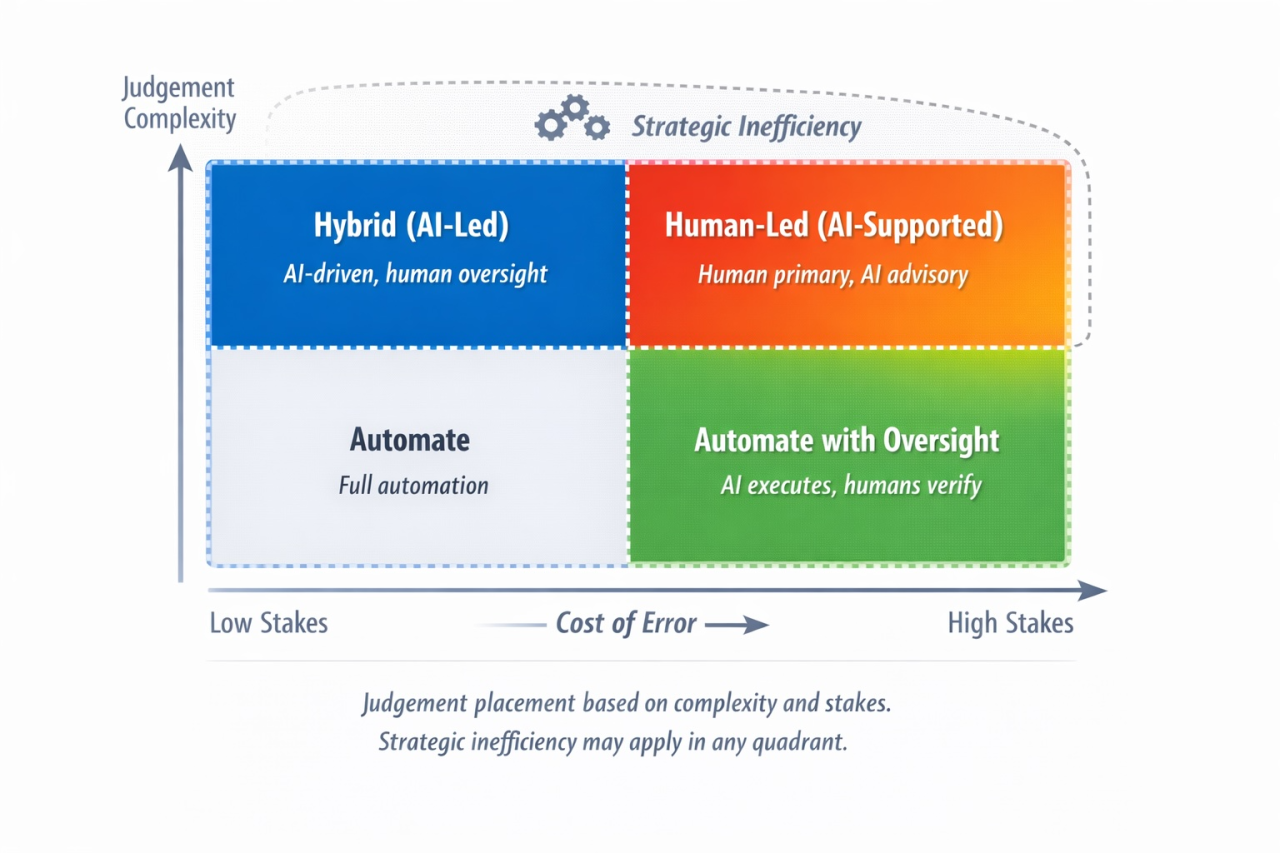
Most real roles land somewhere between categories. They work best as hybrids. The critical decision is not whether to automate, but where to draw the boundary — and that boundary should be designed intentionally rather than allowed to drift. When boundaries are unclear, accountability weakens, escalation becomes arbitrary, and human skills quietly atrophy.
How placement connects to capability maps
Capability maps from Article 3 show where judgement currently lives. The placement decision asks where it should live. Bounded intelligence from Article 5 enables the move.
The sequence matters: map capabilities first, define them as bounded intelligence second, then decide placement. Attempting placement without proper specification produces brittleness — AI implementations that fail at edges because the role was never defined well enough to anticipate them.
The map also reveals interdependencies. A role might be specifiable on its own but dependent on another that is not. If content review depends on brand guidelines that change based on client conversations, placement depends partly on how quickly those changes propagate.
When to revisit placement
Judgement placement is not a one-time decision. It is a hypothesis about where responsibility should sit, and like any hypothesis it needs to be tested against reality.
The most useful signals come from how errors appear. Occasional mistakes are not a failure — they are information. What matters is whether errors cluster at specific boundaries. Repeated failures at the same edges usually indicate that the boundary is wrong: either the role was specified too narrowly, or judgement has been delegated beyond what the system can reliably support.
Escalation patterns offer a second signal. Excessive escalation suggests that AI authority is too constrained, forcing humans to intervene in decisions that could safely be handled autonomously. Too little escalation is more ambiguous. It may reflect excellent specification — or it may indicate that decisions are being made without sufficient human scrutiny. Stable, interpretable escalation is healthier than silence.
Changes in capability also matter. What required expert human judgement last year may now be partially or fully specifiable. Placement decisions should be periodically revisited not because something is broken, but because the frontier of what can be delegated keeps moving.
Organisational values shift as well. A company that once prioritised efficiency may later discover that relationships, trust, or reputation matter more. When values drift, placements optimised for an earlier intent quietly become misaligned. The system continues to function, but it optimises for the wrong outcome.
Revisiting placement, then, is not about chasing novelty or eliminating human involvement. It is about maintaining alignment between judgement, responsibility, and what the organisation actually cares about. The danger is not that placements are imperfect, but that they become invisible — treated as settled facts rather than design choices that require ongoing attention.
The marketing agency revisited
How do these placement decisions apply to the marketing agency from earlier articles?
Content generation: routine social posts get AI drafts with light review. Strategic messaging: humans lead. The boundary — AI never publishes without review, but review depth varies by content type.
Content review: AI handles routine checks. Humans review anything mentioning competitors, clients, pricing, or legal matters. AI can request revisions but cannot approve flagged categories alone.
Client relationship management: sensing relationship health requires expert judgement that resists specification. Humans handle substance, AI handles logistics. The account manager's "excessive" call time is protected as deliberate inefficiency.
Quality review: AI performs first-pass checks. Humans sign off on anything reaching clients.
The same function gets different placements in different contexts. Content review for internal documents: heavy automation. For client-facing work: hybrid. For crisis communications: human primary.
The strategic layer
Bounded intelligence is mechanics — how to define a role. Placement is strategy — deciding where judgement should live. The goal is not perfect placement but the capacity to place intelligently, monitor outcomes, and adjust.
Get it wrong and you either waste human attention on decisions AI could handle, or delegate decisions that require human judgement. Neither failure is immediately catastrophic. Both accumulate.
But placement is only part of the story. Knowing where judgement belongs does not tell you how much judgement the organisation can safely carry. The next article explores what happens when you scale decisions rather than people — and how to know when you have scaled past your governance capacity.