The E-Myth operating system: what this actually looks like in practice
Capability maps, bounded intelligence, placement decisions — what building an AI-first business operating system looks like over twelve months.

Part 9 of The E-Myth, revisited again
What remains is the practical question: what does building an AI-first business operating system actually look like when you’re building it from scratch — not as isolated concepts, but as a coherent operating system?
Articles 1 through 8 built the theory in layers. Capability maps replaced org charts. Bounded intelligence specifications replaced job descriptions. Policies replaced procedures. Placement decisions replaced assumptions about who does what. Leverage density replaced headcount as the scaling metric. And stewardship replaced the idea that you can build a system and walk away from it.
Each concept was illustrated through the same marketing agency. But those were snapshots — isolated demonstrations of individual ideas. What they didn’t show is the order you’d actually build this in, the dependencies between components, or what happens when theory meets the specific, frustrating reality of a business that already exists and already has problems.
That’s what this article is for. Not a recap. A construction manual.
What follows is the story of one agency founder building an AI-first operating system over twelve months — the order she built it in, the mistakes she made, the governance that saved her, and the operating rhythm that emerged. Every concept from the series shows up, but through doing rather than explaining.
Where to start (and where not to)
The temptation is to begin with a capability map. It's the most comprehensive framework in the series, and there's a certain logic to mapping everything before you change anything. Don't.A capability map drawn before you’ve built anything is fiction. You’ll spend weeks cataloguing functions, drawing boundaries, debating whether client relationship management belongs in the coordination layer or the design layer — and none of it will survive contact with reality. It’s the AI-era equivalent of writing a 60-page business plan before you’ve spoken to a customer.
Start with pain. Pick the function that’s consuming the most founder time, generating the most errors, or creating the biggest bottleneck. For most small professional firms, this is something operational — content production, report generation, invoice processing, initial client intake. Something that happens frequently enough to learn from quickly and carries low enough stakes that mistakes during the transition won’t damage client relationships.
For our marketing agency founder — let’s call her Sarah — the answer was obvious. She was spending twelve hours a week writing first drafts of client blog posts. Not because she was the best writer on the team, but because she’d never managed to fully hand off the voice and context for each client. The classic technician trap, updated: she wasn’t clinging to the work because she loved it, but because the implicit knowledge in her head had never been made explicit enough for anyone — or anything — else to use.
Content generation would be the first bounded intelligence role.
The first specification — getting it wrong usefully
Sarah sat down to write the specification using the framework from Article 5. The ten components: objective, decision authority, decision boundaries, inputs, outputs, constraints, trade-off guidance, failure modes, escalation triggers, success criteria.The first draft took her an afternoon. It was, by her own assessment three weeks later, about 40 per cent right.
The objective was fine: produce first-draft blog posts matching each client’s established voice, topic guidelines, and content calendar. Decision authority was where things got vague. She wrote “can select topics from the approved content calendar and determine article structure.” That sounds reasonable. It isn’t precise enough. Can the system combine two calendar topics into one post if they’re related? Can it adjust the word count if the topic doesn’t support 1,200 words? Can it skip a calendar slot if there’s nothing substantive to say?
Every ambiguity in the specification is a decision the system will make on its own, using whatever logic seems locally optimal. Sometimes that logic will be fine. Sometimes it won’t. And you won’t know which until a client notices.
The escalation triggers were worse. Sarah initially wrote “escalate when the topic is sensitive or controversial.” This is the “when in doubt” problem. AI doesn’t experience doubt, and “sensitive” is not a category it can reliably identify without explicit criteria. She learned this when the system produced a post about a client’s industry that touched on recent redundancies — technically accurate, tonally disastrous. Not sensitive by any dictionary definition, but absolutely the kind of thing a human would flag.
The revised escalation triggers were specific and observable: any topic involving named individuals, legal proceedings, financial performance, personnel changes, or industry controversies less than 30 days old. Still not perfect — but testable and improvable.
And that’s the essential insight about first specifications: they are not supposed to be right. They are supposed to be explicit. An explicit specification that’s wrong in specific, identifiable ways is infinitely more useful than an implicit understanding that’s wrong in ways nobody can see.
Placing the first role
With a working specification, Sarah faced the placement decision. The specifiability spectrum and risk tolerance framework gave her a structure, but the answer wasn't clean.Content generation sits in the middle ground. The mechanical parts — researching a topic, structuring an argument, producing grammatically correct prose — are highly specifiable. The judgment parts — knowing that this client’s audience responds better to case studies than statistics, sensing that a topic is overexposed this month, recognising that a particular angle would conflict with something the client said publicly last quarter — are not.
Sarah placed it as a hybrid: AI produces first drafts, a human reviews before anything reaches a client. That much was straightforward. The harder question was where to draw the boundary within the hybrid. Does the AI get the client’s full content history? Their brand guidelines? Their social media presence? Each additional input makes the AI’s output better and the review faster — but also increases the blast radius if the specification has a gap.
She started conservative. AI gets the content calendar, the brand voice document, and the last six published posts for each client. No access to social media, no access to client communications, no access to strategic planning documents. The human reviewer fills those gaps.
An important principle that doesn’t appear in any framework: when placing a role, the scope of information access is as important as the scope of decision authority. A role with narrow decisions but broad information access can still cause damage through what it reveals in its outputs.
From one function to two — and the coordination problem
Content generation worked. Not perfectly — the review process caught roughly one post in five that needed significant rework in the first month, dropping to one in ten by the second. Sarah was getting back eight hours a week. The temptation was immediate: do the same thing everywhere.Good instinct. The next function she tackled was content review itself — not replacing the human reviewer, but giving them AI-assisted tools: automated checks for brand voice consistency, factual accuracy against the client’s published positions, and SEO alignment with the content calendar.
This was a different kind of specification entirely. Content review is a coordination-layer function. Its inputs include the outputs of content generation, which means the two specifications have a dependency. And that dependency surfaced problems that neither specification anticipated in isolation.
The content generation spec said “produce first drafts matching the client’s established voice.” The review spec said “flag deviations from the client’s brand voice document.” But what happens when the brand voice document is outdated — when the client’s actual voice has evolved through six months of posts that the AI generated and the reviewer approved? The generation system is now matching a voice that the review system helped create, and both are drifting from the original document without anyone noticing.
That’s what it looks like when the system starts talking to itself. It’s not dramatic. It’s not a cascade failure. It’s a slow, invisible convergence that only becomes apparent when someone outside the loop — in this case, the client — says “these posts don’t really sound like us any more.”
The fix wasn’t technical. It was governance. Sarah added a quarterly voice calibration to the content generation specification: compare recent outputs against the original brand voice document and the client’s own recent communications, flag any drift, and escalate for human review. A simple mechanism — but one that could only be designed after the interaction between two functions had been observed.
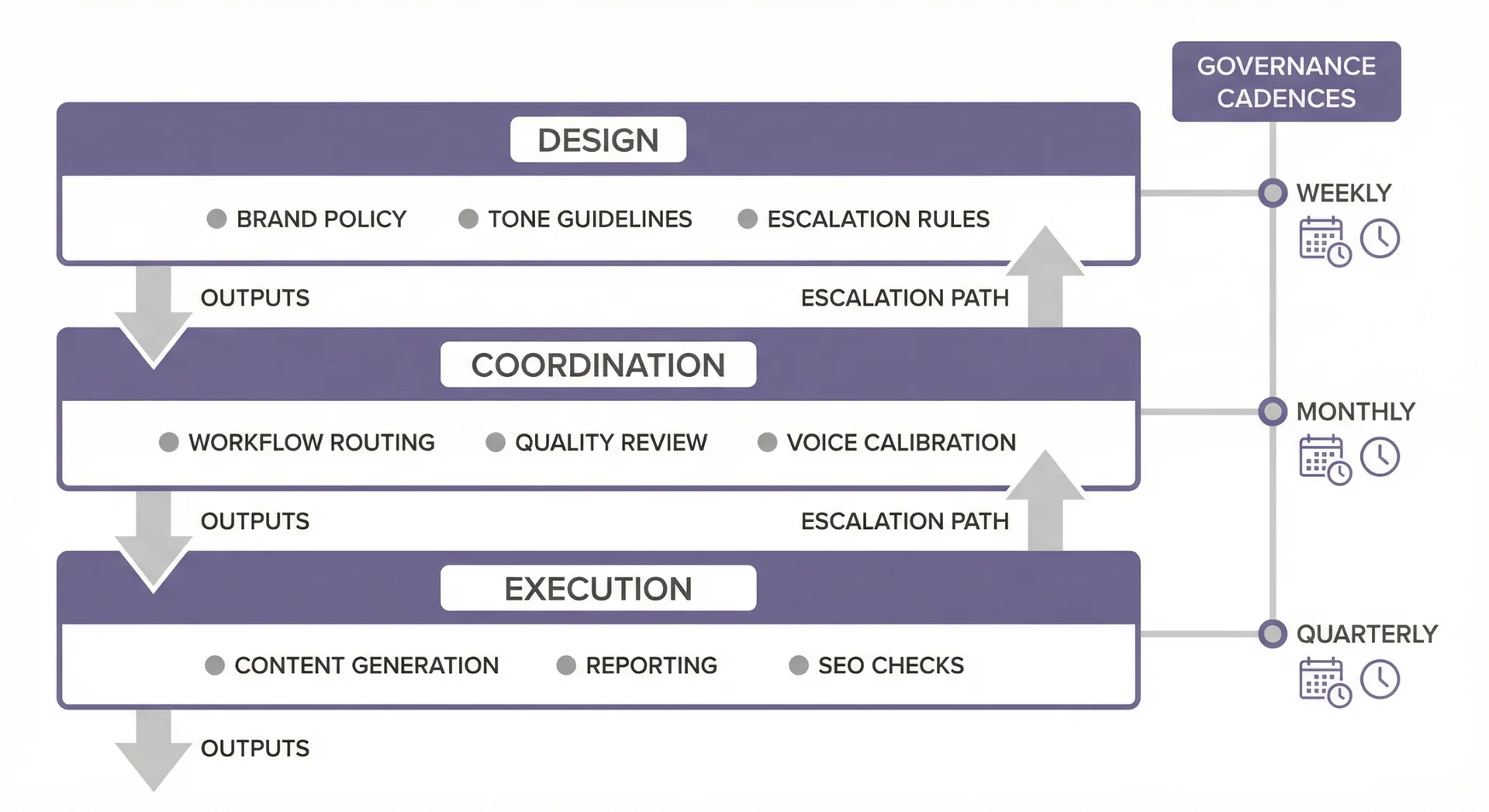
The capability map Sarah had resisted drawing at the start? She needed it now. Not as a grand architectural blueprint, but as a practical tool for understanding how two functions interact and where the coordination gaps are. The map grew from doing, not from planning.
Scaling before you're ready (and catching yourself)
By month four, Sarah had three bounded intelligence roles operating: content generation, review assistance, and monthly reporting. The agency had twelve clients. A referral brought in a conversation about taking on eight more.The maths looked easy. Content generation scaled without additional cost. Review assistance made each reviewer faster. Reporting was almost fully automated. Eight more clients meant roughly 60 per cent more revenue with maybe one additional part-time hire.
This is the leverage density trap. The output scales, but the governance doesn’t. Sarah’s three specifications were calibrated for twelve clients. She personally reviewed escalations, updated specifications when edge cases appeared, and maintained relationships with every client. With twenty clients, each of those activities would grow — and some would grow faster than the revenue.
The signal that caught her was subtle. She wasn’t missing escalations — not yet. But she’d started approving them faster. Where she used to spend ten minutes on a flagged post, reading the context, checking the client’s recent communications, considering the angle, she was now spending three. The escalation was still happening. The judgment behind the escalation response was thinning.
This is one of the clearest warning signs of scaling past governance capacity: the process looks the same but the substance has changed. Escalations become rubber stamps. Reviews become skims. Policy checks become assumptions that nothing has changed since last time.
Sarah took on four of the eight clients instead of all eight. She hired a senior content strategist — not to produce content, but to share the governance load. The new hire’s job wasn’t operational. It was reviewing escalations, maintaining client voice calibrations, and flagging specification gaps. A stewardship role, distributed.
She also restructured her service offering. The twelve existing clients kept full-service content management. The four new clients got a lighter tier: same content generation and review, but monthly reporting instead of weekly, and quarterly strategy reviews instead of monthly. This wasn’t just a pricing decision. It was a governance decision — matching the level of oversight to the capacity available.
Building governance before you need it
The smartest thing Sarah did — and she'd be the first to admit it was partly luck — was building governance mechanisms during the specification design phase rather than retrofitting them later.When she wrote the content generation specification, she also created an assumption register. Every assumption embedded in the specification got documented: “client brand voices change slowly” (assumption), “the content calendar reflects current client priorities” (assumption), “SEO best practices are stable across quarters” (assumption). None of these were controversial at the time. All of them would eventually be wrong.
The assumption register wasn’t a monitoring tool. It was a prompt for periodic questioning. Every quarter, Sarah reviewed each assumption and asked whether it still held. Most did. The ones that didn’t — the client whose brand had pivoted after a merger, the SEO landscape shift when AI-generated content started affecting search rankings — were caught before they corrupted outputs.
She set up policy review cadences early: weekly operational reviews (are escalations working, are outputs meeting standard), monthly specification reviews (are the rules still appropriate), and quarterly strategic reviews (are the policies still aligned with what clients actually need). The weekly reviews took fifteen minutes. The monthly reviews took an hour. The quarterlies took a half-day.
The cadences felt like overhead in months one and two, when everything was working and there was nothing to find. By month six, they were the only reason the system was still aligned. Not because something catastrophic had happened — but because a dozen small things had shifted, and without a structured reason to look, each shift would have been individually too minor to notice.
The paradox of good governance: it feels like a waste of time when it’s working, because you never see the problems it prevents. The temptation to skip a review because everything seems fine is exactly the moment the review matters most.
The operating rhythm
By month six, Sarah's week had a structure that would have been unrecognisable to her a year earlier.Monday mornings: fifteen-minute operational scan. Dashboard showing volumes, escalation rates, review pass rates, client feedback. Not reading every data point — looking for anomalies. A spike in escalations might mean a specification needs updating. A drop in review revisions might mean quality is improving — or that the reviewer is getting less rigorous.
Wednesday afternoons: escalation pattern review. Her content strategist handled most escalations day-to-day, but Sarah reviewed the patterns. Which clients generate the most? Which content types? Are the triggers still calibrated, or catching too much noise?
First Friday of each month: specification review with the team. What’s working? What edge cases have appeared? Which assumptions have weakened? Specifications get updated here — as maintenance, not crisis response.
Last week of each quarter: the strategic review. Are policies still aligned with client needs? Should any functions move between human and AI? Has the leverage density ratio crept past governance capacity?
None of this was operational work. Sarah wasn’t writing posts, reviewing content, or building reports. She was maintaining the system that did those things — the stewardship role that Article 8 described as the founder’s irreducible contribution.
The work was real. It required discipline, attention, and judgment. It was also, by any traditional measure, a fraction of the hours she’d previously spent in the business. The quality of those hours was different — higher stakes, more consequential, and harder to delegate. But there were fewer of them, and they were focused on the right things.
When things go wrong — and they will
Month eight brought the first real failure. A client in financial services had published their annual results, which included a workforce reduction. The content generation system, following its specification correctly, produced a blog post for that client about "building resilient teams in uncertain times." Technically, the post matched the content calendar, the brand voice, and every constraint in the specification. Tonally, publishing an article about team resilience the same week you've made people redundant is, at best, tin-eared.The escalation triggers didn’t catch it. “Personnel changes” was in the list, but the trigger was designed for the client’s own personnel changes appearing in the content — not for external context that made scheduled content inappropriate. The specification was correct. The specification was incomplete.
Sarah’s response was instructive. She didn’t panic, didn’t scrap the system, didn’t add thirty new escalation triggers to cover every conceivable scenario. She added one mechanism: a weekly context check that cross-references each client’s recent public communications against scheduled content, flagging potential conflicts. And she updated the assumption register to include “the content calendar remains appropriate regardless of external events” — marked as false.
The second failure was slower and less visible. Over three months, the review team’s ability to evaluate content quality had gradually degraded. They were spending less time on each review, relying more on the automated voice-consistency checks, and losing the instinct for what “good” looked like independent of what the metrics said. This was competence drift — the human capability atrophying because the system made it less necessary to exercise.
The fix was a monthly calibration exercise: each reviewer manually writes one piece of content per month without AI assistance, then compares it to the AI-generated output. Not because the human version is necessarily better — often it isn’t — but because the act of writing maintains the judgment required to review.
Both failures made the system stronger. Both were inevitable. The point of designing governance in from the start isn’t to prevent failures — it’s to make failures visible, contained, and instructive rather than silent, compounding, and corrosive.
A year in: the AI-first business operating system in practice
Twelve months after Sarah started redesigning her agency as an AI-first operating system, the numbers told one story. Revenue up 45 per cent. Team size up by one (the content strategist). Client satisfaction scores marginally higher than before. Content production volume up threefold.But the numbers missed the more important transformation. Sarah’s role had fundamentally changed. She wasn’t working in the business — Gerber’s original insight still held there. But she also wasn’t working on the business in the way Gerber meant it. She wasn’t designing workflows or writing procedures. She was maintaining intent. Auditing assumptions. Calibrating the boundary between what the system decides and what humans decide. Holding accountability for outcomes that no individual component — human or AI — had fully authored.
The capability map now covered seven functions across three layers. Each had a bounded intelligence specification, a placement rationale, documented assumptions, and defined governance cadences. The map wasn’t finished — it would never be finished, because the business and its context never stop changing. But it was explicit. Testable. Improvable.
The operating system wasn’t something she built and then ran. It was something she initiated and then maintained. The maintenance was the work.
That distinction — between building and maintaining, between a blueprint and an operating system — is what separates the AI-first business from the franchise model that Gerber envisioned. Gerber was right that the founder’s job is to work on the business, not in it. What’s changed is what “working on the business” actually means when the business can think for itself.
That’s where the series concludes — in Article 10.