Marketing's two-front war: when AI disrupts both the tools and the audience
AI is reshaping marketing on two fronts: the tools your team uses and the audience you reach. Most teams watch just one and miss the one that matters.

Every marketing team I talk to is busy adopting AI. They've bought the content tool, they're piloting the ad-optimisation platform, someone's testing personalised email. It feels like progress, and in a narrow sense it's exactly that. But almost none of them are watching the other half of what's happening: the half where their customers start using AI too. And that second half is the one that decides whether anyone finds them at all.
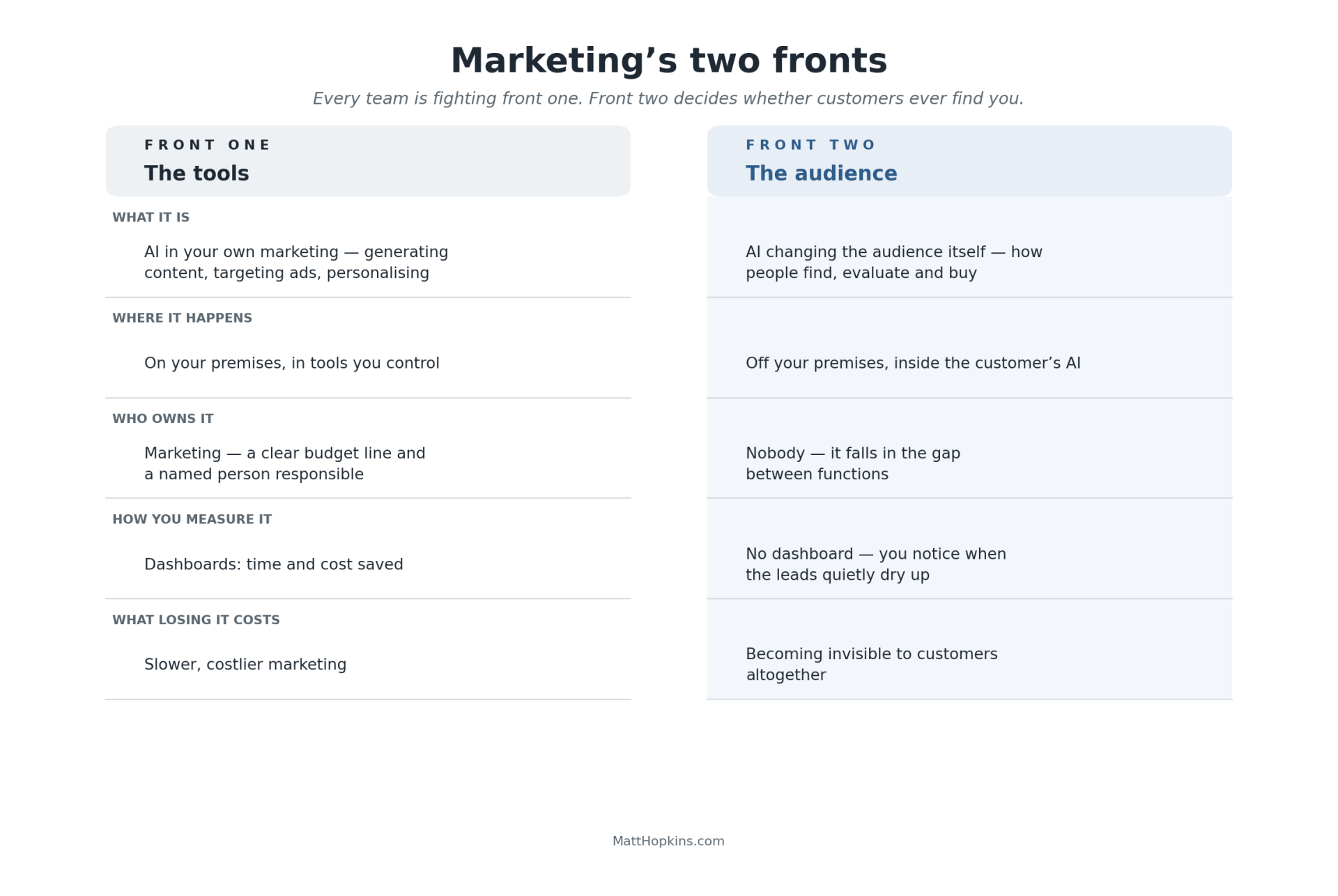
There are really two fronts here, and they pull in opposite directions. The first is AI as a marketing tool: generating content, targeting ads, personalising at scale. This is the front everyone's on. The second is AI changing the audience itself — how people search, how they weigh up their options, and increasingly, who does the actual buying. Most teams are fighting hard on the first front and have barely registered that the second one is even open.
The second front matters more, and not by a small margin. Strip the first one back and it's really about doing the same marketing faster and cheaper. That's worth having. But it leaves the game itself exactly as it was. The second front changes whether the game still exists. It's about whether the mechanism by which customers discover and choose you still works. You can win that first one outright (every process automated, every campaign humming) and still watch your pipeline quietly empty — because you lost the second front without ever noticing it was being contested.
Why everyone's crowded onto the first front
It's the comfortable one. Operational AI lives on your premises. You can see it, measure it, and put it in a board deck. “We've cut content production time by 40%” is a sentence a marketing director can say with a straight face and a slide to back it up. It feels like doing something about AI, and, more than people like to admit, it photographs well.
The second front offers none of that. It happens somewhere you can't see: inside a customer's ChatGPT session, inside the recommendation logic of a platform you don't control, eventually inside a purchasing agent acting on someone's behalf. There's no dashboard for it. There's no obvious owner for it.
It doesn't announce itself; it just slowly moves the numbers until somebody asks why the leads dried up. Given a choice between a problem you can measure and a problem you can't, every team in the world picks the one they can measure.
That isn't stupidity. It's human. It's also exactly how you lose a war on the front nobody's looking at.
What's actually happening on the second front
Two things, mostly, and Stefano Puntoni — a marketing professor at Wharton — set both of them out in a Harvard Business Review piece this February. The first is discovery.
For twenty years, being found meant ranking on Google, and an entire industry grew up around feeding that machine. The machine is now being hollowed out. Roughly 60% of Google searches already end without a click to any website, and when an AI-generated answer sits at the top of the page, that figure climbs past 80%. The precise numbers shift depending on who's measuring, but the direction hasn't wavered in two years.
Think about what that means in practice. Someone wants to understand a problem your product solves. They ask. They get a synthesised answer and a sense of which options are worth considering, then they move on. They never landed on anyone's website, and never saw the brand someone worked hard to build. If your marketing assumes a human will arrive, read your copy, and feel something — a fast-growing share of the time, that human simply isn't coming.
I've written about this shift on its own, about how AI didn't break marketing so much as expose which content was ever worth finding. The encouraging part is that the new discovery layer rewards genuine structure and expertise over volume and keyword games, which is good news if you actually know something. But the point that matters here is plainer than that: the channel changed, and it changed on the customer's side of the table, not yours.
The second thing is buying. How fast that one arrives, I'm not sure anyone can say. The discovery shift is already here; you can measure it today. The agent-buying shift is still mostly forecast, and forecasts about AI timelines have a poor recent record. But the direction isn't really in doubt. AI agents are beginning to act as buyers: software that researches options, tests them against criteria a human has set, and completes the purchase. I've called this the agent-first brand — the one whose next customer doesn't have eyes. An agent doesn't respond to your brand film or your tone of voice. It parses structured data, pricing, and specifications. If it can't read you, it can't choose you, however much a human might have loved you.
Put discovery and buying together and you stop seeing two separate trends. You see one audience: an audience that finds you differently and, before long, buys differently, and behaves less and less like the human reader your whole marketing function was built to persuade.
The front with no owner
Picture the quarterly review where marketing presents its AI progress. The productivity numbers look good: content out faster, campaigns better targeted, costs down. Everyone nods. Nobody in the room can say what's happening on the second front, though — and that's the organisational problem underneath all of this.
The first front has an owner. There's a budget line for marketing tools, somebody runs the content platform, the CMO can name the person responsible. The second one, in most companies, has nobody.
Ask who owns “how we show up when a customer asks an AI about our category” and you get a shuffle of feet. The SEO team sense it's drifting away from them. The brand team don't think machine-readability is their job; they do feelings, not feeds. Product assume it's a marketing problem. Marketing assume it's a technical one.
So it sits in the gap between functions, which is the most dangerous place for anything important to sit, because gaps don't appear on anyone's objectives. The C-suite signs off on a set of AI tools and reasonably believes it now has an AI strategy. What it actually has is a strong position on one front and an undefended flank on the other.
The fix here is mundane, which is exactly why it gets skipped: somebody senior has to own the second front by name. An actual person whose job includes how the business shows up to an AI, with the standing to pull brand, product, and marketing into the same room. Until that person exists, the flank stays open — everyone can see the problem, and nobody is accountable for it.
Auditing both fronts
The fix isn't complicated, though it does mean admitting the second front is real. Audit your marketing on both fronts separately, and don't let a strong score on the first reassure you about the second.
- Operational adoption: are we using AI well in our own work? Content, targeting, personalisation, analysis. Most teams have a reasonable answer here. If you don't, it's the easier gap to close, because the tools are sitting right there waiting to be used.
- Audience-side discovery: if a customer researches our category through an AI, do we appear, and are we described accurately? Ask the major models about your space and read what comes back. If you're absent, or misrepresented, that's a finding to act on, not a curiosity to note.
- Machine-readability: if an agent evaluated us, could it? Structured product data, transparent pricing, specifications a model can parse. “Contact us for a quote” is a wall to an automated buyer; it'll just move to the next supplier in the feed.
The reason to score them apart is to stop the first front flattering you. A team can be genuinely excellent at operational AI and completely exposed on the audience side, and the operational wins are loud enough to drown out the silence on the other one. Keep the numbers separate, or the comfortable score hides the dangerous one.
None of this means giving up on operational AI. Faster, cheaper, better-targeted marketing is worth having. But it's fast becoming table stakes: everyone will have those tools, and soon, which means none of it will be much of an advantage for long. The advantage, if there's one to be had, sits with the teams who also do the less glamorous work of staying findable, and staying legible, to an audience that no longer behaves like the one in the textbook.
The marketers who come through this well won't be the ones with the most AI tools on their own side of the desk. They'll be the ones who noticed early that the customer was the thing that changed — and understood that no amount of automation on your side ever fixes a problem that lives on theirs.