When AI agents start hiring humans — and on whose terms
AI agents are starting to hire and manage humans, not replace them. What matters is on whose terms your people enter the loop, and who is left liable.
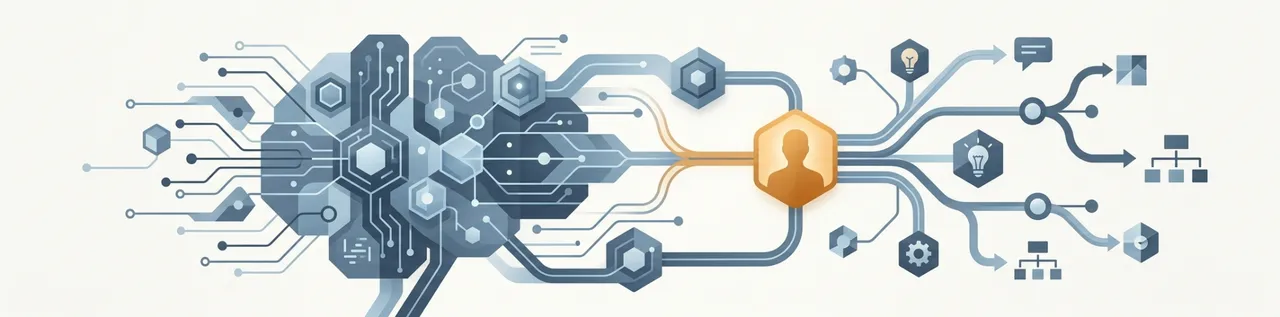
A claim comes in. An AI agent reads it, pulls the policy, checks the details against the cover, and drafts a recommendation: settle it, or don't. For most claims that's the end of the story — the agent handles it and moves on. But this one sits slightly over a threshold, or the wording is ambiguous, so the agent does something that would have looked strange a couple of years ago. It stops, packages up what it found, and routes the case to a qualified human reviewer. The reviewer approves, amends or rejects. The agent records the decision and closes the file.
Notice what's happened to the person in that story. They used to be the invisible exception, the thing that got handled quietly over email when the system couldn't cope. Now they're an explicit, callable step in someone else's workflow. The software decided when to involve them, what they'd get to see, and what they were allowed to do about it.
There's a bit of informal shorthand going round for this: the “human in the cloud”, a person you can summon into an automated process the way you'd call up any other service. It's a useful picture and I'll borrow it, but let's be clear that it's a marketing phrase rather than an established category. The engineers have their own tidier terms — human-in-the-loop for the reviewer who has to approve before anything happens, human-on-the-loop for the one who only steps in when something looks off. Real distinctions, worth a sentence, not worth a lecture. The shift that actually matters sits underneath all of them.
The handover has reversed
For most of the last thirty years the deal ran one way. We handed the boring, repetitive, rules-based work to software — the sums, the sorting, the sending — and kept the judgement for ourselves. What's changing now is the direction of travel. The software increasingly does the routine work end to end and passes the hard bits back to us: the ambiguous call, the thing that needs verifying, the action that has to happen out in the physical world. And it doesn't only ask nicely. It's starting to act as the buyer, the dispatcher and the manager of that human work — which is to say the tool you bought to manage things has started, in a small way, managing people instead.
So set aside whether people stay in the loop. Of course they do. The near-term future of this technology is a hybrid one, and anyone selling you the fully self-driving company is selling you a brochure. What matters is on whose terms people enter the loop: how much authority, visibility and genuine value gets designed into the role, and how little.
If you want the sharp end of it, there's a marketplace called RentAHuman that launched earlier this year, where AI agents hire people for the jobs they can't do themselves (check an address, photograph a shelf, collect a parcel) and pay them, in crypto, by the hour. Agents plug into it the same way they plug into any other tool. It's tempting to read that as the future landing, and just as easy to over-read it: when researchers actually looked, they found far fewer active workers than the headline numbers claimed, and a $40 job to collect a package that thirty people applied for and nobody finished. This is still an experiment, and a ragged one. But it's an experiment that treats a human being as a callable resource, and it runs on the same plumbing everyone else is laying down. It's mostly noise for now, but it points at something real: a workflow you designed can reach out and set a stranger to work on your behalf, which makes how you wire it your problem rather than the vendor's.
Where the terms actually get set
The reason this matters is that the choices which decide how it goes are being made right now, mostly by default, by people building quickly. A few of them carry more weight than the rest.
Start with what the person actually sees. When an agent escalates a case, it also frames it. Google's own guidance for these systems says an approval request should show the reviewer what the agent plans to do, why, and what could go wrong, which is exactly right, and exactly the thing that gets skipped when someone's shipping fast. A reviewer shown only the agent's tidy summary is approving the agent's version of events, not the events themselves. The framing does the deciding; the human does the signing.
Then there's whether they can meaningfully say no. There's a world of difference between a review and a rubber stamp, and it usually comes down to time and standing. Amazon's guidance for its own agent platform includes something it calls “return of control”, where the person can change the parameters rather than just wave the action through. That's the right instinct, because approval without the power to amend or refuse isn't oversight, it's decoration. A tick-box at the end of a queue, with a clock running and forty more cases waiting behind it, doesn't turn into governance just because the audit log files it as one.
And that audit log is its own problem. These systems record who approved what, with a name and a timestamp, for all the compliance reasons you'd expect. Which means that when the agent's framing was wrong and a human signed it off under pressure, there's now a named person bolted to the mistake: not the software, and not the vendor. This is where the piece meets something I wrote a little while back, that AI agents are not a staffing strategy because an agent can do the work but can't be answerable for it. Turn that round and you get the flip side of the same coin: the accountability has to land on a person, so it lands on whichever human touched the thing last, whether or not they ever had a real chance to catch anything.
There's also the matter of the people themselves. A global pool of humans doing small paid tasks on demand has been around for the best part of two decades; Amazon's Mechanical Turk built a business on it, with workers often paid in pennies per task and famously little protection. The new part is the dispatcher. When the thing assigning and rating the work is an autonomous agent rather than a manager, the old questions about how those workers are vetted, paid and treated don't disappear. Nor does a newer one: an agent that hands a task to a stranger can hand a slice of your customers' data along with it, to someone nobody thought to check. The questions just get harder to see, because there's no person in the frame to hold responsible. There's a workflow.
None of which is an argument against putting humans in these systems. The genuine benefits are easy to list: edge cases handled by someone who understands them, expertise applied at the point where it changes the outcome, and a good deal less human drudgery in the routine flows that never needed one. A well-designed human-in-the-loop step is one of the better ideas in agentic AI. What should worry us is the badly-designed version — the cheap approval button bolted on to make a risky process look supervised — and that's the one that costs less to build.
There's a prior question that tends to get lost, too: which tasks actually need a human at all. Some of what gets escalated is genuine judgement. Some of it's just a gap where better rules or safer software design should have been, with a person dropped in to soak up the risk the system didn't want to own. Telling those two apart is most of the work, and it's the same discipline as deciding what your agents are allowed to touch in the first place.
On whose terms
I won't try to predict where all this ends up. I don't think anyone knows the shape of it yet, and I'd be wary of anyone who tells you they do. What I'd say instead is that it's a choice, and a surprisingly granular one. Every time a workflow gets wired so that a person is called in at the right moment, shown the real evidence, given the time and the standing to disagree, and paid properly for the judgement they bring — that's one version of the future. Every time a person is slotted in as a cheap, fast, callable exception handler whose main job is to be the name on the approval — that's the other. Both are being built this year, in code, by people who mostly aren't thinking about which of the two they're choosing.
If your business is going to have humans in its agent workflows, and it almost certainly is — whether you're the one wiring them in or the one being called — the terms are worth setting on purpose. The technology will happily set them for you, and its default is the cheap one.