The agentic readiness gap: 85% of enterprises want agents, 76% can't support them
85% of enterprises want agentic AI but 76% lack the operational foundation. Why process visibility matters more than model capability.

The ambition is running miles ahead of the infrastructure. That’s not a hunch — it’s 1,600 global business leaders saying so in black and white.
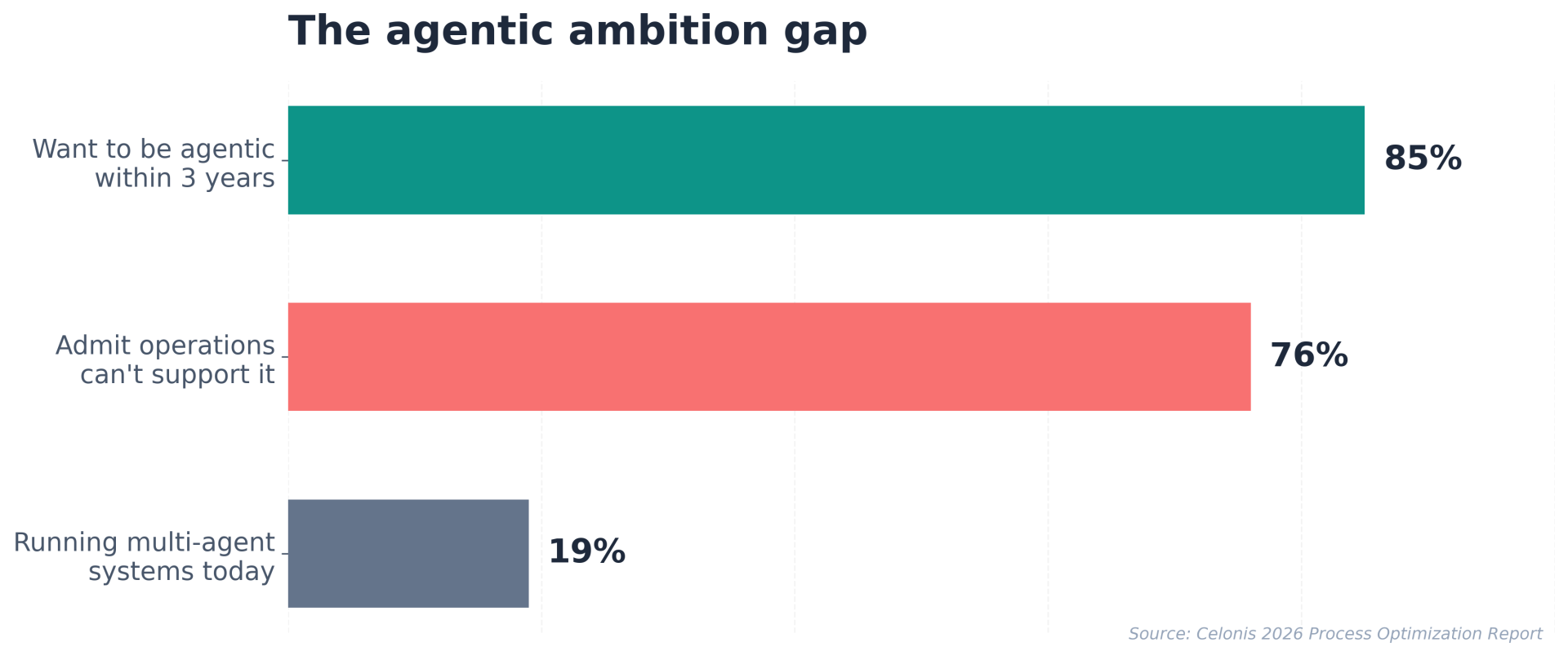
Celonis released its 2026 Process Optimization Report last month, and the headline numbers tell a story that should make every leadership team uncomfortable. 85% of enterprises want to become an “agentic enterprise” within three years. 76% admit their current operations can’t support it. Only 19% are actually running multi-agent systems today.
Read those numbers back. The gap between ambition and operational reality is so wide you could lose an entire transformation programme inside it.
The problem isn't what you think it is
Most leadership teams assume the bottleneck is the AI itself. It isn't. The models are good enough. The tooling is maturing fast — Nvidia is about to launch NemoClaw, an open-source enterprise agent platform, at GTC this week. Multi-agent orchestration frameworks exist. The raw capability is there.The problem is that most organisations have spent decades building processes that were “good enough” for humans but break the moment an AI agent tries to navigate them. Siloed teams (54% of respondents flagged this), lack of cross-department coordination (44%), and processes so tangled that even the people running them can’t fully explain how they work.
AI agents need to understand how your business actually runs. Not the org chart version. The real version — the KPIs that actually drive decisions, the unwritten policies, who really signs off on what, and where the handoffs between departments quietly fall apart. That knowledge is usually trapped in departmental silos, built up over years of “we’ve always done it this way”.
Without that operational context, your agents are guessing. And 82% of decision-makers believe AI will fail to deliver ROI without it.
The execution gap is widening
Deloitte's State of AI 2026 report paints a similar picture from a different angle. Access to AI tools has jumped 50% year-on-year — around 60% of workers now have sanctioned AI tools available. But fewer than 60% of those workers actually use them regularly. The tools are there. The integration isn't.Only 25% of organisations have converted at least 40% of their AI pilots into production systems. Just 34% are genuinely reimagining how the business works rather than bolting AI onto existing processes. And when it comes to agentic AI specifically, only 21% have mature governance frameworks in place — despite nearly three-quarters planning to deploy autonomous agents within two years.
Gartner has gone further, predicting that over 40% of agentic AI projects will be cancelled by the end of 2027 due to escalating costs, unclear business value, and inadequate risk controls. They estimate only about 130 of the thousands of agentic AI vendors are genuine — the rest are “agent washing”, rebranding chatbots and RPA tools with a fresh coat of agentic paint.
That’s a lot of money about to be spent on expensive guesswork.
Process before agents, not agents before process
Patrick Thompson, Celonis's global SVP of customer transformation, put it well: "You can't bolt AI onto a broken process and expect it to work. True enterprise modernisation means redesigning how teams, systems, and decisions connect — and AI only works when that modernisation happens first."This is the bit that nobody wants to hear, because it’s boring. It’s not a flashy demo. It’s the unglamorous work of mapping how your business actually operates — building capability maps that show where decisions really happen, making that knowledge explicit and machine-readable, and fixing the process friction that’s been invisible for years because humans were good enough at working around it.
Process intelligence — having a shared, accurate, live picture of how your operations actually run — isn’t just a nice-to-have. It’s the foundation that makes agentic AI viable. Without it, you’re deploying agents into an environment they can’t navigate, asking them to make decisions without the context they need, and then wondering why the results are disappointing.
63% of leaders already use process optimisation to proactively manage risk. 58% say it drives faster decision-making. In supply chain — arguably the sector furthest ahead on this — 66% view process optimisation as a critical business-wide initiative, not a background IT project.
The change management problem nobody wants to admit
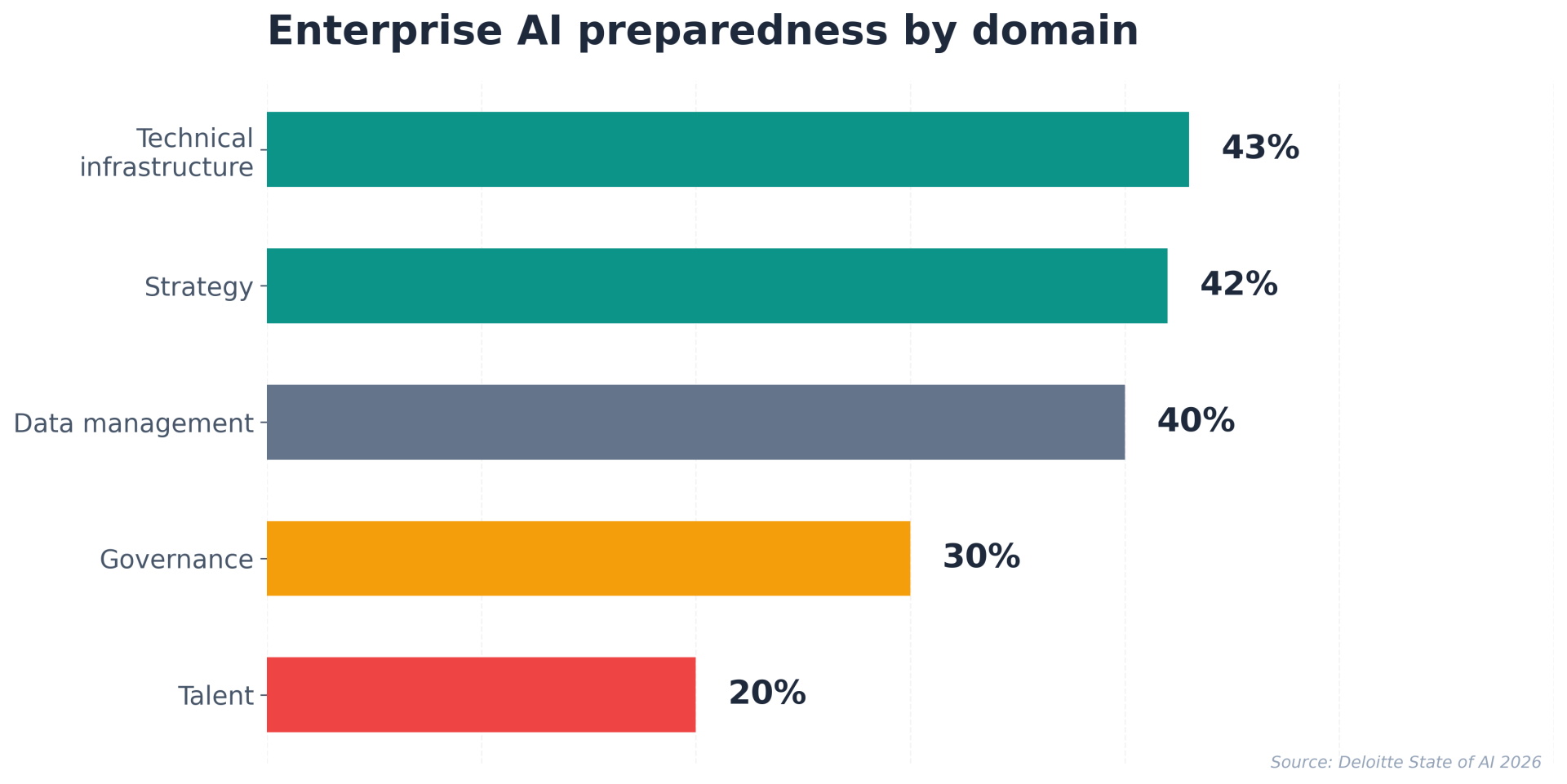
Only 6% of leaders cite resistance to change as a barrier to AI adoption. That number is suspiciously low. What's actually happening is that the resistance isn't showing up as "we don't want AI" — it's showing up as structural inertia. Departments that don't share data. Teams with their own languages, their own systems, their own definitions of success. 93% of process and operations leaders explicitly say that process optimisation is as much about people and culture as it is about tools and technology.When Deloitte digs into preparedness, the numbers are sobering. Strategy readiness? 42% say they’re highly prepared. Governance? 30%. Technical infrastructure? 43%. Data management? 40%. Talent? Just 20%.
What to actually do about it
Before you deploy a single agent, answer one question: does it have a clear, accurate picture of how your business actually works?Not the PowerPoint version. Not the process documentation that was last updated in 2019. The real, live, messy truth about how work flows through your organisation — where it gets stuck, where handoffs break down, where decisions actually get made versus where they’re supposed to get made.
If the answer is no, then you’re not ready for agentic AI. And that’s fine. The companies that will win this aren’t the ones that deployed agents first. They’re the ones who did the hard, unglamorous work of building operational visibility before they turned the agents loose. An honest assessment of where you actually sit on the agentic maturity scale is a good place to start.
The biggest risk right now isn’t moving too slowly on AI — the investment case is structural, not speculative. It’s moving too fast on agents without doing the foundational work first — and ending up as one of Gartner’s 40%.
Process before agents. Context before autonomy. Visibility before intelligence.
It’s not as exciting as a demo. But it’s what actually works.