The £25,850 line: the new cost of a job, and how to plan for it
A nine-staff firm now pays £25,850 more a year in employment costs. Why that's the new floor, not a blip — and how to rebuild your business around it.

A small firm with nine people on the National Living Wage is now paying £25,850 more a year in employment costs to keep exactly the same team it had at the start of 2025. That's the Federation of Small Businesses' figure, and it comes out at a little under £2,900 a head, for the same work, from the same people, at the same desks. The wage went up. Employer National Insurance went up. The threshold where you start paying it came down. Nobody new walked through the door, and the bill still rose by the price of a small family car, every year, repeating.
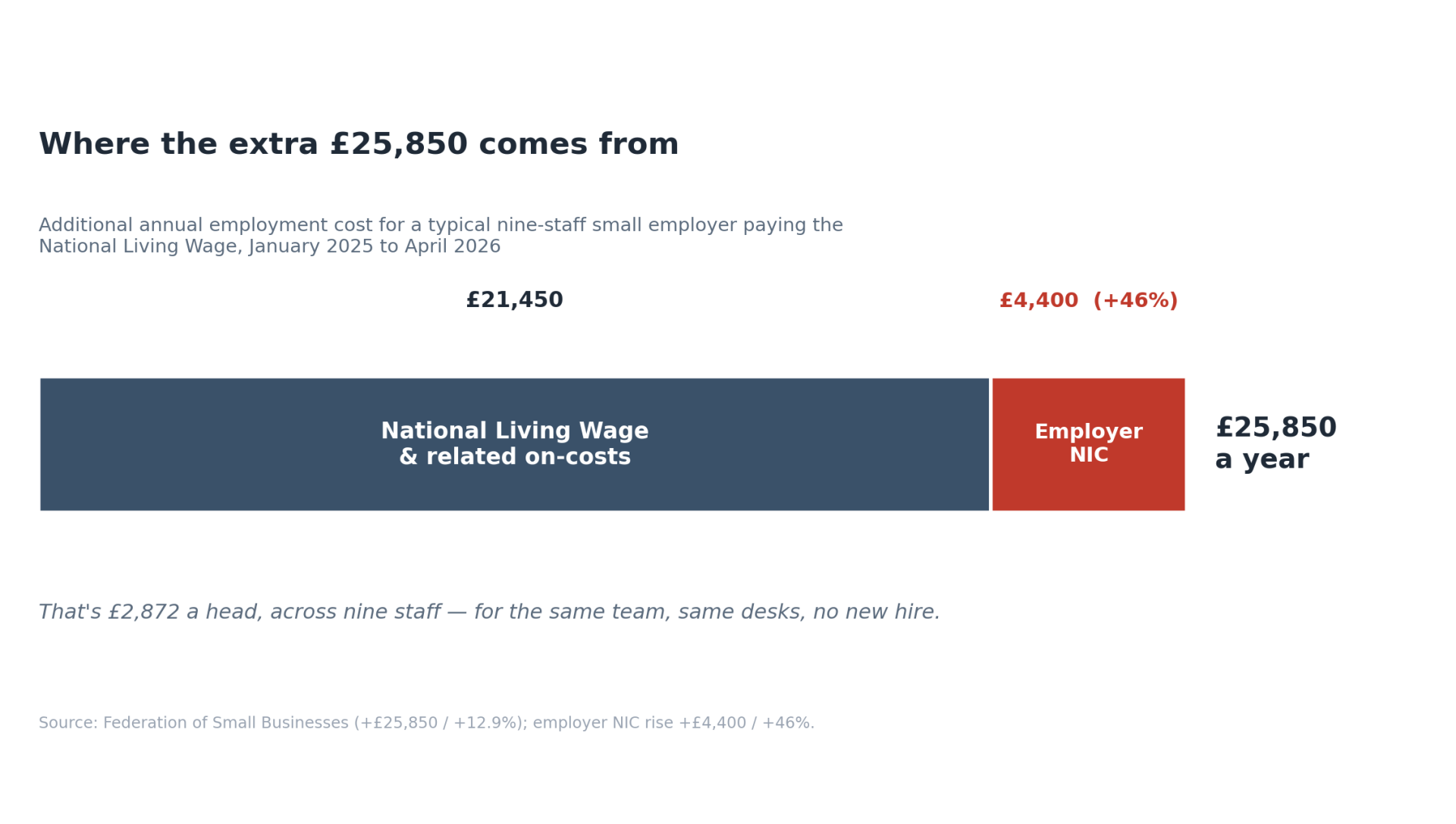
Most of us are treating this as weather. Bad weather, but weather: something that blew in and will eventually blow out, probably after the next Budget, probably with a bit of relief tucked into it for small employers. I understand the instinct. It's also the most expensive mistake you can make this year, and the smarter move is to plan around it now.
The floor is legislated to 2031
The hope inside "let's just get through this" is that the number is temporary: confidence recovers, the Chancellor finds some room, and the cost of a job drifts back toward where it sat in 2024. Nothing in the data supports that hope. The secondary threshold for employer National Insurance, the part that did most of the damage, is frozen until 2031. That isn't a squeeze you wait out. It's a new floor, legislated to stay put for the rest of the decade.
The wider picture offers no rescue either. The Bank of England's agents report subdued growth through 2026 and pay settlements easing toward 3.6 per cent as the labour market loosens; ICAEW's confidence monitor has sat in negative territory all year, with tax named as a worry at record levels. For an owner, that's the worst of both worlds. You can't lean on a buoyant market to pass the cost to customers, and you can't bank on a generous Budget to take it off you. Which leaves the one lever that's genuinely yours: the shape of your own operation.
So the realistic planning assumption is plain: this is the price now, not a number waiting to fall back. And once you accept that, the question stops being how do I survive it and turns into something far more useful: how do I rebuild the operation around it.
What £25,850 actually buys
Per head, the rise is worth roughly £2,872 a year. It helps to think about what that sum is, rather than letting it sit as an abstract line on the P&L.
For a lot of small firms, £2,872 a head is the entire training budget. It's the margin on a decent-sized job. It's the difference between a year where you take something home and a year where you don't. In plenty of cases it's the gap between hiring the tenth person and deciding you can't. Underneath the headline figure, the cost has re-priced every individual decision that sits on top of a salary: every hire, every promotion, every pound of training now starts from a higher base.
That's the bit owners miss when they file the number as a single tax event. It permanently changes the economics of every future decision that involves a person, and it does so for as long as the team exists.
Treat it as fixed, then design around it
The founders who come out of this in good shape will be the ones who do something slightly counter-intuitive: they stop arguing with the number. They book it as fixed, like rent, or the lease on the premises, and then they redesign the business so the higher cost of a head is matched by more value per head.
That can sound like a slogan, but it's really a design problem, and it breaks into three concrete moves.
- Price the cost back in. If a job costs more to deliver, some of that has to move into the price. Owners are oddly squeamish about this — far readier to swallow a £25,850 rise than to put four per cent on an invoice. I've made the case before in pricing, value and the incentive to buy: the firms holding their margin through this are the ones who've stopped apologising for what they charge.
- Lift output before you add heads. If you can't easily take on people at the higher cost, get more from the ones you've got — the question I worked through in scaling without hiring. The tools for raising output per person are cheaper and better than they've ever been, at the exact moment that adding a person got dearer. That timing isn't a coincidence to waste.
- Make every role earn its new cost. At £2,872 more a head, some roles that were comfortable at the old price are underwater at the new one, and not because anyone's underperforming — the maths simply moved. Working that out is uncomfortable. Skip it, and the £25,850 becomes the thing that actually breaks you.
The counter-case: a Budget reprieve
There's a counter-case worth taking seriously. A version of the next Budget could throw small employers a bone — a bigger Employment Allowance, a touch of relief on the threshold — and if it lands, the squeeze eases. I honestly don't know how likely that'll be. The allowance already rose to £10,500 for this year, which genuinely helps the smallest firms. But "it might get marginally better" is a thin thing to build a year on, and even the hopeful version doesn't take you back to 2024.
Planning for the floor and being pleasantly surprised is a far safer way to run a business than planning for the rescue and getting caught out. So treat the £25,850 as what it now is — the standing cost of having a team — and the owners who price for it and build an operation plainly worth the money will still be standing when the ones holding out for a Budget miracle have quietly run out of room.