Process maps show the flow; capability maps show the judgement
A process map shows the order work happens in. A capability map shows where judgement lives. Once AI does the work you need both. Here's how to start.
Business process mapping is a way of drawing how work moves through a business, with the activities that make up a process laid out in the order they happen. It uses a small set of standard symbols — rectangles for tasks, diamonds for decisions and arrows for the flow between them. The common forms are the flowchart, the swimlane diagram, the value-stream map and the SIPOC. A swimlane splits the flow into rows, one per person or team, and a SIPOC fits the suppliers, inputs, process, outputs and customers of a process onto a single page.
A capability map draws something different. In its conventional form it lists what a business is able to do, such as pricing, quality review or client communication, regardless of who does it. The version I find useful adds a layer to each capability, recording where it lives: with a person, with an AI system or with both. It also notes what the capability needs as input, what it produces, the constraints it works within and the triggers that send a decision somewhere else. A process map shows what happens and in what order; a capability map shows where the judgement sits and what it’s allowed to do.
Most owners who’ve drawn a process map believe they’ve mapped their business, and for most of business history that belief was close enough to true. Once AI agents start doing the work, though, the sequence on the page can stay exactly as it was while the judgement underneath it moves, and nothing on the map prompts anyone to redraw it. My view is that we now need both maps, and that the one most of us already have is the one that tells us least.
What process maps assumed
Much of the standard advice on process mapping is sound. Small Business Trends ran an explainer on it last week that covers the benefits most owners would recognise, from clearer communication and easier onboarding to a paper trail for compliance. AI appears in it only as a future trend and as a feature of one product.
The difficulty is that process maps were designed for a world where the step and the person doing it sat in the same box. If the swimlane said the account manager drafts the proposal, we could safely assume the account manager’s judgement shaped the proposal, because nobody else was involved. The map recorded a sequence, but we could read the distribution of judgement off it for free. You can add an AI lane to a swimlane, and some teams do, but an existing swimlane may well predate the arrival of AI in the business.
Now suppose an agent drafts the proposal and the account manager reviews it. The box still says “draft proposal” and the arrow still points to “approve”. The decision that matters most, which price goes in front of the client, has moved to a system working from rules someone wrote months ago. I made the same point about org charts in Org charts are dead; capability maps aren’t, where the chart becomes a map of a territory that no longer exists. A process map drifts the same way, only more slowly and more convincingly, because the flow it describes is still the real flow.
The same pricing decision, drawn twice
Take the client-pricing decision from that article. As a swimlane it’s simple: the account manager proposes a price, the team lead approves it, and the founder steps in to override on any deal above a set threshold. Bring AI into the same business and the swimlane doesn’t need to change, because the account manager still “proposes” — they just send on what the system generated — and every box is still accurate.
Drawn as a capability map, that same operation breaks into four pieces. The price itself is now generated by AI, working within margin rules and the pattern of past deals. A person still reviews it, within their authority limits, and brings what they know of the client that the system doesn’t. Anything outside the system’s parameters gets flagged for a human to decide, which makes exception handling a hybrid, and the founder sets the policy that governs all of it, reviewing the rules each quarter and often going months without seeing an individual price.
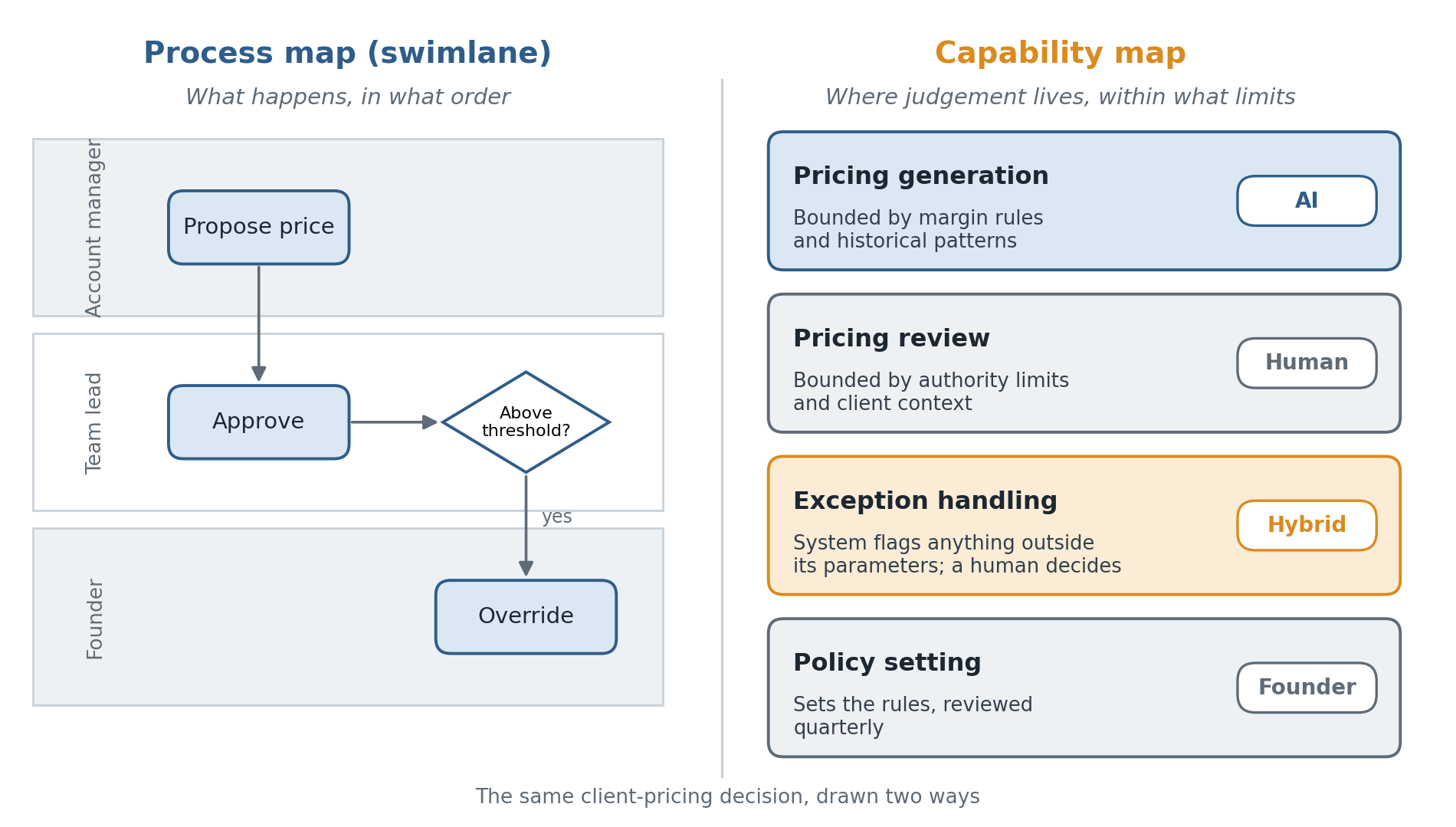
Put the two side by side and the difference is plain enough. The swimlane tells us who touches the deal and in what order, while the capability map tells us that much of the pricing judgement now lives in a set of margin rules, and that the human decision with the longest reach is the quarterly one that sets them. If those rules drift out of date, the swimlane will look healthy right up until a run of underpriced deals shows up in the accounts.
Building a capability map from the process map you already have
There’s no need to start from a blank page. A process map that’s even roughly accurate makes the best scaffold we could ask for, because it already lists the steps, and all we’re adding is the judgement behind each one.
- Start from the existing map. Take the swimlane or flowchart you already have and treat each box as a candidate capability, without redrawing anything yet.
- Ask who or what actually decides. For each step, write down who or what makes the call today, as it really happens rather than as the map says it does.
- Write down what it’s allowed to decide. Record the limits — the price band, the authority threshold, the topics that must go to a human. If nobody can tell you what the limits are, that’s worth knowing too.
- Note the inputs and the hand-off. What does the step need to do its job, and under what conditions does it pass the decision on? Record what it produces, too. Escalation triggers that live only in someone’s head tend to be the first to fail.
- Mark each step human, AI or hybrid. A step where AI drafts and a person skims is closer to AI than hybrid, so save the hybrid label for steps where the person weighs the decision.
- Look for the gaps. You’re looking for steps nobody owns and constraints nobody reviews. For the constraints, give each one a named owner and a trigger for review, such as a change in costs, authority limits or the rate of exceptions.
Delete first, then decide what to hand over
None of this retires the process map, which is still the better tool for one particular job. Musk’s five-step algorithm says we should question and delete before we automate, and a process map is how we find the steps worth deleting, because it lays the whole sequence out where redundancy has nowhere to hide. Once the deleting is done, the capability map takes over and helps us decide which of the surviving steps to hand to an agent, and on what terms. I’m not sure yet how often that second map needs redrawing as a whole. A quarterly look seems a reasonable default for a small business today, but as agents become more capable the distribution may shift faster than any of us review it.
Put simply, we map the process to see the flow and the capabilities to see where it can go wrong, and the easiest place to begin is the process map you already have. Beside each step, write down who or what decides and what it’s allowed to decide, and the gaps you find will be the start of your capability map.
Quick answers
What’s business process mapping, and how is a capability map different? Business process mapping documents a process as a sequence of activities, usually with standard symbols for tasks, decisions and flow; flowcharts, swimlanes, value-stream maps and SIPOC diagrams are all forms of it. A capability map records the capabilities a business depends on and where each one lives — human, AI or hybrid — along with its inputs, outputs, constraints and escalation triggers. The process map answers what happens and in what order, and the capability map answers where judgement lives and within what limits. Before AI you could usually infer the second from the first, but once agents take on the execution that inference stops holding.
Do I need both? If any part of your business runs on AI, yes. In practice, the process map is where you find what to delete, and the capability map is where you decide what to hand over.