AI didn't break the graduate job market. Remote work broke the apprenticeship model.
The New York Fed says remote work, not AI, explains most graduate unemployment. The accidental apprenticeship has gone — here's how to rebuild it now.

Think back to your first proper job and ask yourself how you actually learnt it. For most of us the induction pack and the training budget had surprisingly little to do with it. The real teaching came from sitting within earshot of people better than we were — overhearing how an awkward client call got handled, being corrected before a bad habit could set in, slowly absorbing which questions mattered, which numbers could be trusted, and what the senior people really cared about. Nobody designed any of that. It was an apprenticeship running on proximity, so cheap and so ambient that most organisations never realised they were running one.
That accidental apprenticeship is the missing character in the story we’ve been telling about graduate unemployment. The numbers are grim enough (unemployment among recent US graduates reached 5.6% in March 2026, up from 3.6% in March 2019), and the popular explanation has settled comfortably on AI: the machines do the junior work now, so the juniors aren’t needed. It’s a tidy story with an obvious villain, and the best data we’ve got points somewhere else for the bulk of the damage.
What the Fed actually found
Fast Company has been asking awkward questions about that story for a while, and in June the New York Fed gave the scepticism numbers. In a post titled remote work leaves younger workers sidelined, economists Natalia Emanuel, Emma Harrington and Amanda Pallais estimate that remote work explains around 64% of the rise in unemployment among young graduates since the pandemic. Put plainly: of everything that’s pushed graduate unemployment up since 2019, roughly two-thirds traces back to where we work, not to what the machines can do.
The pattern behind that estimate is easy to picture. In jobs that can be done remotely, young graduates’ unemployment climbed by almost a full percentage point while older workers in those same occupations did slightly better than before; in jobs that can’t be done from home, graduate unemployment wobbled in 2020 and then settled back to normal. The timing confirms it, because the surge began before generative AI had spread into workplaces in any meaningful volume — and when the researchers held occupations’ exposure to AI constant, the age gap didn’t budge.
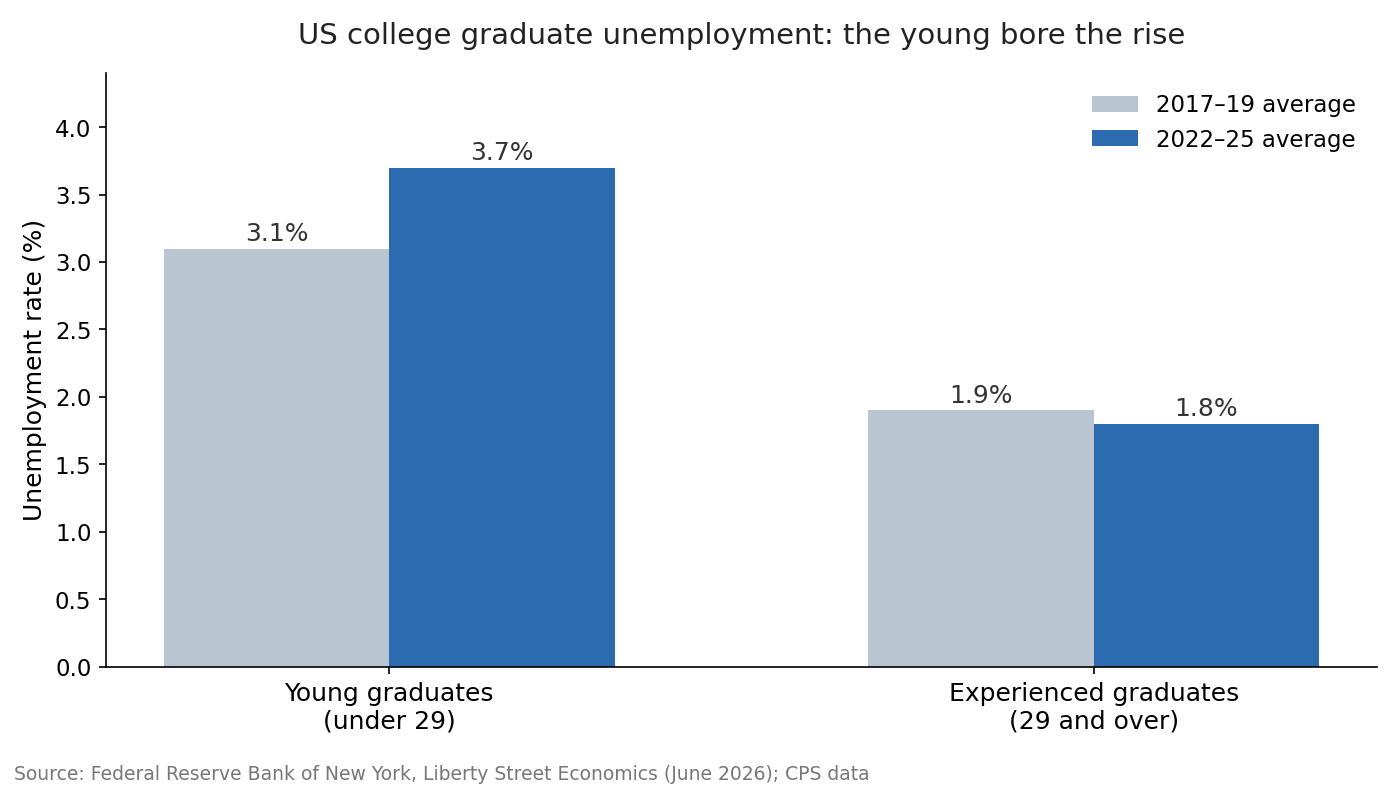
If you run a business, there’s a decision hiding in that comparison. Remote working has real benefits, and nobody feels that more keenly than managers already stretched thin — but if a role can be done from anywhere, the development that used to come free with a desk has to come from somewhere else.
What a company’s payroll admits
The researchers also had access to internal data from a Fortune 500 company, and it confirms what anyone who came up through an office already knows: people who work next to their colleagues receive more feedback and more mentoring, and when even a short distance separates them that feedback tapers off dramatically, with the youngest losing the most. The firm’s hiring behaviour is the giveaway. While its offices were closed it hired fewer inexperienced people and more seasoned ones; when they reopened it went back to hiring juniors — except onto its distributed teams, where it kept hiring experience. That’s a company telling you through its payroll exactly what it believes: we’ll teach young people when they’re near us, and we won’t when they aren’t. One caveat worth carrying with you: this firm-level evidence comes from software engineers at a single company, and how well it generalises to consultancy, finance or healthcare is hard to say — though the aggregate pattern doesn’t rest on one firm.
The apprenticeship nobody designed
This is where I’d push the argument one step further than the researchers do. Remote work didn’t break the graduate training system, because there was no system to break. What we grandly called graduate development was mostly a by-product of seating plans: the junior absorbed the trade because the trade was being practised a desk away, and no one had to budget an hour for it. Take the office away and every one of those accidental lessons has to become a deliberate act: a scheduled call, an agenda item, a manager remembering to share their screen and narrate their thinking. Ambient teaching turned into admin, and much of it simply stopped happening.
I watched this work for seventeen years at my own agency, where the people who grew into roles I could trust with clients were invariably the ones who’d spent their early years close to seniors, watching how difficult conversations were handled. Whether they’d have developed the same judgement remotely I can’t say for certain. But employers across the economy seem to have reached their own conclusion, because they’re choosing to hire people who already have it.
Where AI fits in
AI still belongs in this story, though in a different role from the one the headlines give it. The old apprenticeship had a commercial logic as well as an educational one: juniors earned their keep doing the low-level work — the research summaries, the data cleaning, the first drafts — and that output funded the learning. It was a deal, even if nobody ever wrote it down. AI is now removing precisely that class of work, which means the apprenticeship is losing its business case at the same moment remote work has dismantled its classroom. I’ve written before about the graduation cliff, and the Fed’s authors themselves concede that AI may play a larger part in youth unemployment from here. The two forces compound each other. Remote work took away the teaching; AI is taking away the reasons to tolerate a learner while they learn.
What to do about it
For business owners the practical question is what to do about all this, and I’d start with three things.
- Decide where your juniors learn: the aim is modest — put inexperienced people within earshot of someone worth copying during their formative years, even if the rest of the organisation stays hybrid. Some firms have understood this for a while; the Fed notes that the company it studied had a stricter return-to-office policy than its peers, and that this is exactly what let it carry on hiring young workers.
- Make the invisible curriculum visible: if you’re committed to remote or hybrid working, the informal feedback the office gave away free has to be engineered back in — short feedback loops, reviews of work in progress rather than finished output, juniors sitting in on calls they aren’t strictly needed for. This costs time, which the office used to absorb without anyone noticing.
- Reprice the apprenticeship: with AI handling the grunt work, a junior earns their place by interrogating the machine’s output and building the judgement that AI can’t replicate. Picture a graduate running a first-pass competitor review with AI, checking every claim against the sources, then defending their conclusions to a senior the next morning — the work gets done faster, and the judgement still gets built. On that basis a graduate hire becomes an investment in your leadership pipeline. And as the bottom rung of the career ladder keeps disappearing, the firms that keep building that pipeline will hold a scarce asset.
The bottom line
The apprenticeship most of us served was free, invisible and accidental, and it isn’t coming back on its own. The organisations that rebuild it on purpose — with proximity for the people who need it most, and AI accelerating the learning rather than replacing the learner — will spend the next decade growing the senior people everyone else is trying to buy.