An apartment building full of GPUs: how the money behind AI capex thinks
Investors price AI data centres like apartment buildings full of GPUs. Here is the landlord logic, where it leaks, and how to build so you can switch.
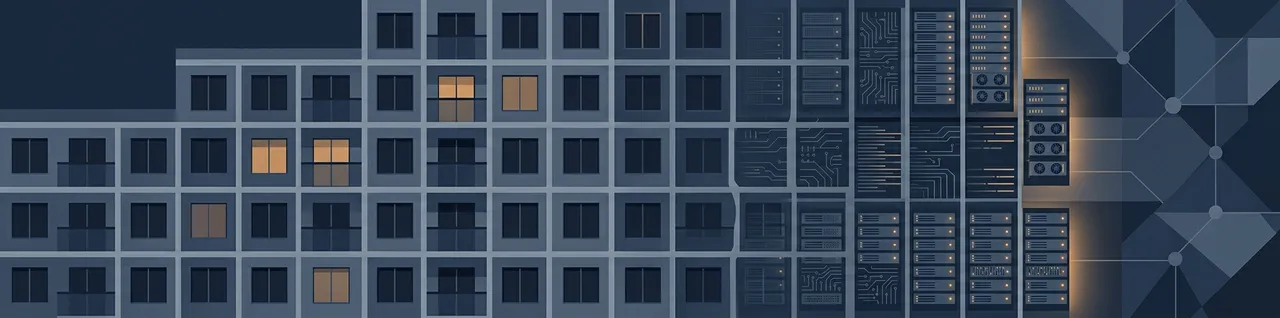
An AI data centre is “really just a multi-tenant apartment building; it just so happens there’s no humans in the apartment building, there’s just GPUs”. The line belongs to the investor and analyst Paul Kedrosky, talking to Alex Kantrowitz on the Big Technology Podcast this month, and he means it close to literally. The funds behind these projects treat them as project finance — the same mental category as a strip mall or a hydroelectric dam. They ask what cash flow the asset will reliably produce, set that against the six-to-seven per cent returns available on comparable property deals, and write the cheque when the arithmetic clears.
Big tech alone is on course to spend roughly $700 billion on capital expenditure this year, heading towards a trillion next, and the commentary on those numbers tends towards either breathless awe or confident predictions of collapse. The landlord’s arithmetic is more boring than both, and it explains more. On rental logic the projects can look perfectly sensible, and no artificial general intelligence is required to make the numbers work. Kedrosky has little patience for what he calls the loony sell-side justifications — the addressable market for human labour is $12 trillion, capture a fifth of it, job done — because the people writing the cheques don’t think that way. A fund putting $50 billion into a campus is comparing the yield against the other places a cheque that size could go, the same judgement a landlord makes between two rental properties.
Two further forces keep the money moving, and neither is a revenue forecast. At sovereign scale, capital filters opportunities by cheque size before it filters by economics — almost nothing else on earth can absorb $100 billion the way a data-centre campus can. And AGI sits in these deals as an unpriceable call option: what would you pay for a call option on immortality? Whatever’s asked. Kedrosky’s report from inside the rooms is that the AGI story gets wheeled out for the funds’ own investors but rarely comes up in partner meetings; the property comparison does the work, and everyone keeps dancing to Chuck Prince’s tune from July 2007 — “as long as the music is playing, you’ve got to get up and dance.”
The scale of the dance floor deserves a moment. On Kedrosky’s analysis this build-out now exceeds most of the great American infrastructure episodes — rural electrification, the interstates, the fibre boom — on measures like contribution to economic growth and share of new borrowing, and as of the second quarter more than half the funding comes from outside investors rather than the hyperscalers’ own cash flows. Electrification took thirty years. Fibre took five or six. This one is being squeezed into roughly three, without the natural pause points that let earlier investors check whether returns were arriving before committing more.
Where the apartment building leaks
An apartment building earns its keep by front-loading the capital: build once, collect rent for decades, spend comparatively little keeping it standing. A data centre refuses to behave that way twice over.
The first leak is that the building’s contents wear out. Around half the build cost sits in chips that need wholesale replacement every four to seven years, and how fast they fail depends on how hard a life they’ve had. Kedrosky’s analogy is two used cars with 5,000 miles on the clock — one raced flat-out across the country, the other driven to church on Sundays. Chips hammered by training runs are the race car, and some are failing inside eighteen months. So the investor who thought they were buying a building that pays back for decades is holding something closer to an unregulated utility: a project that keeps raising fresh capital for its entire life, diluting the return with every round.
Nothing like the second leak appeared in any earlier build-out. The rent on these buildings is paid in tokens — the metered units of AI output that every drafted proposal, summarised document and agent run gets billed in — and the price of a token has been falling by 70 to 80 per cent a year at constant capability for at least four years. Researchers at Epoch AI put the decline nearer 90 per cent for some workloads. Fibre capacity became more valuable after the dotcom crash; railway lines held their worth for a century. Token prices are heading towards zero, so the landlord is collecting rent in a currency that loses most of its value every year.
Jevons paradox is the standard reply: cheaper tokens, vastly more usage, revenue holds up. The demand growth is real. But Kedrosky’s arithmetic says offsetting a price decline compounding at that rate would need token volumes to grow by something like a million-fold over the next six years, and while he concedes it’s possible, he doesn’t think it’s likely. I struggle to see it too.
Renting in a market like this
Few of us are funding data centres, but nearly every business now rents what they produce, so the endgame lands on our cost lines whichever way it goes. Kedrosky’s picture of that endgame is electricity: AI becomes a utility, and “I will no more know who provides my tokens than I do from which hydroelectric dam the power came from that’s powering my MacBook right now”. Every pressure in the story pushes in that direction — models converging in capability, competition shifting to price, token deflation carrying on.
Earlier this year I wrote that agents mean this isn’t a bubble, because agent workloads have transformed the demand side of the compute equation. Kedrosky’s lens sidesteps that argument rather than contradicting it; real demand and fragile financing can both be true at once, which is roughly how the fibre story went. Whether this ends in a crash or a slow re-rating I don’t know, and I’m wary of anyone who’s certain.
Where the durable value sits is easier to say: in the layers we control. Most AI capability already lives outside the model — in the harnesses, workflows and institutional data wrapped around it — and commodity-priced models only make that more true. The practical test is switchability. A business whose proposals, reviews and reporting run on documented workflows and its own data can change model provider in an afternoon; one built around a single lab’s premium product is carrying a dependency it hasn’t priced. If the towers turn out to be overbuilt, the switchable business buys its tokens cheaper in the fire sale. If they don’t, you’ve lost nothing by building that way.